Here’s a number most vendors won’t put in their brochure: 60% of first-time crypto exchange founders spend at least twice their initial quote before going live. The headline price for a cryptocurrency exchange clone script in 2026 starts at $8,000 and runs well past $80,000 depending on what’s actually included. This guide breaks down exactly what drives that number, which add-ons will catch you off guard, and what a realistic launch budget looks like for a startup founder who needs to move fast without burning through capital.
What’s Inside a Clone Script Package
Most vendors sell you three things at the base price: a frontend, a backend, and a basic wallet module. That’s it.
The standard package in 2026 includes a trading engine, user and admin dashboards, KYC and AML verification flow, a web interface, and 30 to 90 days of post-launch support. Order matching speed, liquidity API access, mobile apps, cold storage setup, and server infrastructure are almost always sold separately, or left entirely to you.
One team we worked with signed a $14,000 contract expecting a production-ready exchange. What they got was a script on the vendor’s shared hosting with no root access, a generic UI, and an order book that failed to match trades in real time under load. Moving to their own AWS environment added $1,800 in setup fees and $900 more per month in running costs. The vendor wasn’t dishonest. They just never told the full story.
Know exactly what the package includes before you sign. Ask for a written component checklist. If the vendor resists, that’s your answer.
Pricing Tiers in 2026: What Each Budget Gets You
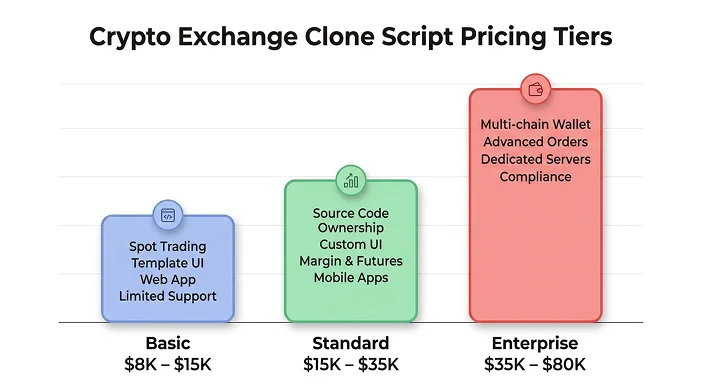
Clone script vendors in 2026 price across three distinct tiers. Here’s what each one actually delivers.
Basic: $8,000 to $15,000. You get spot trading, a template UI, a web app, and 30 to 60 days of post-launch support. Source code at this tier is often licensed rather than owned outright. Customization options are thin. Providers like Oyelabs and AppcloneX offer packages in this range. Don’t expect custom branding or any derivatives module.
Standard: $15,000 to $35,000. This is where most serious founders land. At this tier you get full source code ownership, a custom UI skin, margin and futures trading modules, Android and iOS mobile apps, and 3 to 6 months of support. Most vendors include liquidity API integration with one provider at this price point.
Enterprise: $35,000 to $80,000. This is for teams launching at institutional scale. Expect multi-chain wallet support, advanced order types including iceberg, stop-limit, and OCO, a dedicated server setup, multi-jurisdiction compliance modules, and a full white-label branding package. Deployment at this tier takes 8 to 14 weeks.
And the honest reality: anything under $10,000 is a template, not a product. Any vendor selling a “full-featured” exchange at $5,000 is running a shared codebase that dozens of other exchanges are already using. That’s not a risk you want to inherit on day one.
CEX vs DEX vs P2P: Cost by Exchange Type
The exchange model you pick changes the cost profile significantly. They’re not the same product.
CEX clone scripts (Binance and Bybit style) are the most mature codebases on the market in 2026. The order matching engine is prebuilt, wallet custody is centralized so on-chain costs stay lower, and the admin layer is battle-tested across hundreds of deployments. A Binance clone script starts at $12,000 for a basic version and reaches $45,000 for a full derivatives build with mobile apps. A Bybit clone script with futures and perpetual contracts typically falls between $20,000 and $40,000.
DEX clone scripts cost more. You’re paying for smart contract development, and every deployment costs gas. A Uniswap-style AMM clone on Ethereum runs $18,000 to $60,000. Multi-chain support across BSC, Polygon, and Solana adds $8,000 to $15,000 on top of that. Every smart contract also needs a security audit before you launch. Credible audit firms charge $5,000 to $20,000 depending on contract complexity. Skipping the audit is how projects lose their entire liquidity pool in week one.
P2P exchanges sit between the two. Escrow logic, dispute resolution systems, and local payment integrations all add to the base cost. A WazirX-style or Paxful-style P2P clone runs $15,000 to $30,000 for a complete build.
| Exchange Type | Starting Cost | Full Build | Smart Contract Audit |
|---|---|---|---|
| CEX (Binance / Bybit style) | $12,000 | $40,000 to $50,000 | Not required |
| DEX (Uniswap / PancakeSwap) | $18,000 | $50,000 to $80,000 | $5,000 to $20,000 |
| P2P (WazirX / Paxful style) | $15,000 | $30,000 to $45,000 | Not required |
| Hybrid (CEX + DEX) | $25,000 | $60,000 to $100,000+ | Required |
If your budget is under $30,000, don’t try to build a hybrid. You’ll run out of money before QA is finished.
The Add-Ons Most Vendors Don’t Mention
This section is where first-time founders get blindsided.
KYC and AML integration. Providers like Sumsub, Onfido, and Jumio all charge per verification, typically $1 to $3 per user at any real volume. Integration work runs $2,000 to $5,000 separately if your vendor doesn’t include it as part of their base package. Many don’t.
Liquidity API integration. Without a market maker or a liquidity bridge, your order book is empty on day one. No trader creates an account on an exchange with no liquidity. Connecting to a provider like B2BX, Shift Markets, or AlphaPoint costs $3,000 to $8,000 in integration work, plus monthly fees starting around $1,000. Budget for both.
Cold wallet storage. Skipping this is genuinely dangerous. We’ve seen this go wrong more than once. One exchange kept over 30% of user funds in a hot wallet to reduce withdrawal friction. They lost it all in a breach during their third month live. BitGo’s cold storage integration runs around $5,000 to set up. Fireblocks MPC-based custody starts at $10,000. Consider this non-optional.
Server infrastructure. A production-grade exchange on AWS or GCP, with load balancers, Redis for order book caching, and automated failover, costs $800 to $2,500 per month. The $10/month VPS your vendor demonstrates the product on won’t handle 500 concurrent users. It won’t handle 100 on a busy trading day.
Your Real 12-Month Cost of Ownership
The headline price gets you the script. The total cost of ownership is what you spend over your first year live.
| Cost Item | One-Time | Monthly |
|---|---|---|
| Clone script (standard tier) | $25,000 | — |
| KYC / AML integration | $3,000 | $500 to $2,000 |
| Liquidity API setup | $5,000 | $1,000 to $1,500 |
| Cold wallet setup | $5,000 | $200 |
| Server infrastructure | $2,000 | $1,200 |
| Security audit | $8,000 | — |
| Legal and compliance | $5,000 to $15,000 | — |
| Marketing (minimum viable) | $10,000 | $3,000+ |
| Year 1 Total | $63,000 to $73,000 | $6,000+ per month |
That’s a significant number compared to the $25,000 headline quote. But it’s still a fraction of building from scratch, which runs $200,000 to $500,000 and takes 12 to 18 months. The math on clone scripts isn’t just about the script cost. It’s about time to revenue.
How to Launch Under $50,000
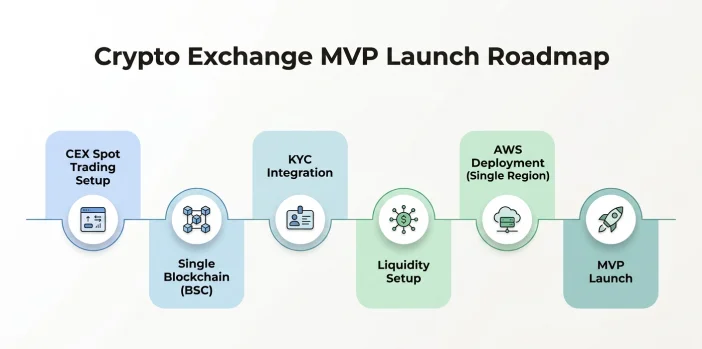
It’s possible. But you need to make deliberate trade-offs upfront, not accidental ones mid-build.
Start with a CEX, not a hybrid. Spot trading only in version one. Futures and margin can come after you have real trading volume to justify the added complexity. Pick one blockchain at launch. BSC is the most cost-effective to deploy on in 2026 and has the lowest on-chain transaction fees for your early users.
For KYC, Sumsub’s startup plan runs under $200 per month at low verification volumes. That’s plenty to get through your first 1,000 verified users. For liquidity, explore a revenue-share model with a market maker rather than committing to a flat monthly fee before you have trading activity.
If you’re targeting the Indian market or launching from India, development companies in cities like Bangalore, Chennai, and Hyderabad typically quote 30% to 40% less than equivalent vendors in Dubai or Singapore for the same codebase quality. A white label crypto exchange under $50,000 is most realistic with an India-based provider who can show you a live deployment on their own infrastructure, not just screenshots.
Launch on a single AWS region first. Mumbai is the right choice for Indian operations. Scale infrastructure when volume justifies it. Don’t over-provision before you have paying users.
What to Verify Before You Sign
Most vendors present well. Product quality varies a lot more. Here’s what to check before you commit to anyone.
Ask for a live demo, not a recording. Watch a working order book with real bid-ask matching in real time. Test deposit flow, withdrawal, and order placement in a single session lasting at least 20 minutes. If the vendor stalls or offers you a recorded walkthrough instead, that tells you something about the actual product.
Get source code ownership in writing. Some vendors license the code rather than transfer it. If you ever want to white-label the exchange to other businesses, raise venture funding, or sell the company, you need full code ownership. This should be explicit in the contract, not implied or buried in terms.
Check the support SLA carefully. “24/7 support” on a vendor’s site often means a WhatsApp group with a 12-hour response window on weekends. For a live exchange where withdrawals can break at 3am on a trading day, that’s not acceptable. Get response time commitments and escalation paths written into the contract with penalties for breach.
Ask directly about security history. Find out if any of their deployed exchanges have experienced a breach, a hot wallet drain, or a smart contract exploit. If they can’t answer clearly, or they deflect, take that seriously.
Review our complete feature breakdown, deployment timeline, and cost structure before you shortlist vendors. The right provider answers all of these questions without hesitation. The wrong one gives you a sales deck.
Frequently Asked Questions
How much does a Binance clone script cost in 2026?
A Binance clone script costs $12,000 to $45,000 in 2026 depending on features. A basic version with spot trading and a web interface starts around $12,000. A full build with futures, margin trading, a mobile app, and liquidity integration runs $35,000 to $45,000.
What’s the cheapest way to launch a crypto exchange in 2026?
The cheapest path is a basic CEX clone script with spot trading only, one blockchain (BSC), and a startup KYC plan like Sumsub. Total initial spend can stay between $12,000 and $18,000 if you negotiate hosting into the contract and defer futures and mobile apps to version two.
Does a crypto exchange clone script include liquidity?
Not usually. Most clone scripts include the ability to connect a liquidity API, but the connection itself, and the monthly cost of the liquidity provider, is separate. Budget $3,000 to $8,000 for integration work and $1,000 or more per month for an ongoing liquidity bridge.
How long does it take to deploy a crypto exchange clone script?
Deployment takes 2 to 4 weeks for a basic CEX clone. A standard build with custom UI and mobile apps typically runs 4 to 8 weeks. Enterprise builds with multi-chain wallets and institutional compliance modules take 8 to 14 weeks from contract signing.
What’s the difference in cost between a CEX and DEX clone script?
DEX clone scripts cost more because of smart contract development and mandatory security audits. A basic DEX clone starts at $18,000 versus $12,000 for a CEX. A full DEX build on multiple chains can run $60,000 to $80,000, while a full CEX tops out around $45,000 to $50,000.
Is crypto exchange development cheaper in India?
Yes, meaningfully so. India-based development companies typically quote 30% to 40% less than vendors in the UAE or Singapore for equivalent quality. For startups targeting the Indian market, this makes local providers the most practical starting point for a cost to launch crypto exchange India budget.
What hidden costs should I budget for?
The main ones are KYC integration ($2,000 to $5,000 setup, plus per-user fees), liquidity API ($3,000 to $8,000 setup, $1,000+ per month), cold wallet storage ($5,000 to $10,000), server infrastructure ($800 to $2,500 per month), and a security audit ($5,000 to $20,000 for DEX contracts).

