Over 65% of new crypto exchanges that launched in 2024 ran on some form of white label infrastructure. Not because founders couldn’t code, but because building a matching engine that doesn’t collapse under $2M in daily volume takes 14 months minimum. The global crypto exchange platform market hit roughly $45.9 billion in 2023 and is projected to reach $264 billion by 2030. The window is open, but it won’t stay that way forever.
If you’re a startup founder deciding between building from scratch and buying a white label solution, this guide gives you the actual numbers, the real tradeoffs, and the questions your vendor probably hopes you don’t ask.
Why Founders Choose White Label Over Building From Scratch
Building a crypto exchange from scratch is a legitimate option, but you need at least $300,000 and 18 months to do it correctly. Most startup founders don’t have both.
The matching engine alone is a hard problem. It has to handle thousands of concurrent orders, process buy and sell matches in microseconds, and never lose a transaction even if the server crashes mid-trade. We’ve seen teams spend $80,000 and 9 months on this single component only to discover their engine couldn’t handle more than 200 concurrent users without dropping orders. They eventually scrapped it and went white label. By that point, two competitors had already launched.
White label solves the speed problem. A good provider ships you a battle-tested codebase built on Node.js and Web3 infrastructure that’s already survived real trading volume. You don’t pay for the R&D that went into it. You pay a fraction of that cost for the right to use it.
Compliance is the other driver. In 2026, operating an unlicensed exchange isn’t a gray area anymore. Regulators in the EU, UK, and across Asia-Pacific have enforcement budgets and are using them. A white label platform with built-in KYC/AML modules saves you 3 to 6 months of compliance engineering and around $40,000 in consultant fees.
Choose white label if you’re under $200,000 in budget, need to launch within the year, or don’t have a blockchain engineering team assembled. Build from scratch if you have $500,000, a specific trading product no existing platform supports, and a tech co-founder who has shipped exchange infrastructure before.
What’s Actually Inside the Software
Most providers list features. Few explain what those features mean operationally.
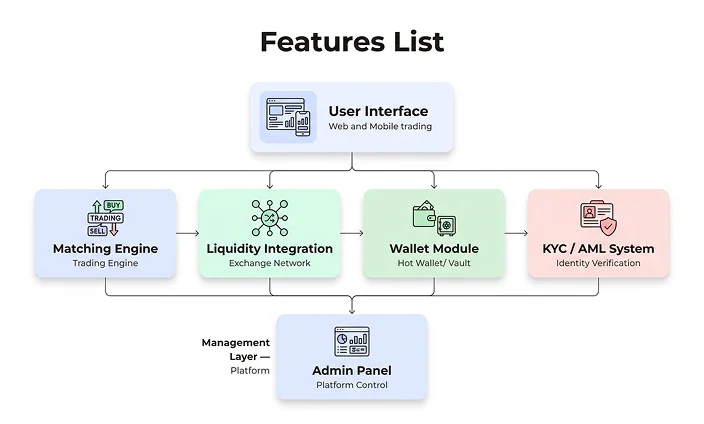
The Matching Engine
The core. It’s the logic that takes a buy order for 0.5 BTC at $82,000 and matches it against a sell order at the same price in real-time. A production-grade engine handles at minimum 10,000 transactions per second. Anything less and you’ll see order slippage during high-volume market events, which kills user trust fast.
Liquidity Integration
Connects your exchange to external order books so users can trade even before you’ve built your own user base. Without it, your platform looks empty. This is the most overlooked feature in early planning and the most important one.
The Admin Panel
Where you run the business. You set trading fees, manage user tiers, freeze accounts flagged by compliance, monitor withdrawal queues, and pull revenue reports. Ask any provider to demo the admin panel specifically, because this is where quality gaps show up.
The Wallet Module
Handles hot and cold storage. Any provider that can’t explain their hot/cold ratio upfront is a risk you don’t want to take. The industry standard is keeping under 5% of funds in hot wallets. Some providers let you integrate Fireblocks or BitGo for institutional-grade custody.
KYC/AML Tooling
Typically integrates with providers like Sumsub, Jumio, or Onfido. Your platform captures ID documents, runs liveness checks, and screens against sanctions lists. This isn’t optional in 2026.
Real Costs: What You’ll Actually Pay
The $15,000 to $30,000 figure you’ll see everywhere is the entry point. Here’s the fuller picture.
Licensing or purchase fee: $15,000 to $60,000 upfront. Development-house white label packages sit in the $15,000 to $35,000 range. Enterprise SaaS platforms are priced differently, often with monthly fees starting at $5,000 to $15,000 and no large upfront payment.
Third-party integrations: Budget $3,000 to $10,000 for KYC provider setup, payment gateway integration, and liquidity API connections.
Infrastructure: Cloud hosting on AWS or GCP for a production exchange runs $800 to $3,000 per month. One exchange we know launched on a $200/month server and went down for 6 hours during a BTC pump. They lost $120,000 in trading volume in one afternoon and didn’t recover their user base for months.
Compliance and legal: $5,000 to $25,000 depending on jurisdiction. Some regions require a VASP license. Others require MSB registration.
Post-launch maintenance: $1,500 to $5,000 per month for security patches, feature updates, and technical support.
Total realistic budget for a startup exchange launch: $40,000 to $100,000 in year one.
The Launch Timeline Nobody Tells You About
Vendors say 2 to 4 weeks. The real number is 6 to 16 weeks, and here’s why.
Weeks 1–2: Contract signing, onboarding, and initial platform access. You’ll spend most of this time on paperwork and staging environment credentials.
Weeks 3–5: Branding and customization. Logo, color scheme, domain, and email configuration. Custom UI changes beyond a theme swap add 2 to 4 weeks.
Weeks 5–8: Integration work. KYC provider setup, payment gateway configuration, and liquidity API connections. This is where timelines slip most often. Payment processors have their own onboarding queues.
Weeks 8–12: Testing. Testnet trading, order book stress tests, withdrawal flow audits, and security review. One team launched without a proper withdrawal audit and discovered their bulk withdrawal queue processed the same transaction twice under certain network conditions.
Weeks 12–16: Compliance sign-off, banking partner setup, and mainnet deployment.
The shortest realistic timeline for a properly tested exchange is 10 weeks. If a vendor promises 2 weeks, ask them which of these phases they’re cutting.
Compliance and KYC: The Part Most Guides Skip
Don’t skip this section. Unlicensed exchanges get cease-and-desist letters, banking relationships cut, and founders face criminal liability in some jurisdictions.
In the EU, MiCA now applies. You need VASP registration, AML policies, Travel Rule compliance for transfers above 1,000 EUR, and regular reporting to your national financial authority. In the US, you’re looking at FinCEN MSB registration and state-by-state money transmitter licenses if you’re serving American users.
Your KYC setup needs to handle three things well: identity verification at onboarding, ongoing transaction monitoring for suspicious patterns, and sanctions screening against OFAC, EU, and UN lists. Most white label platforms integrate with Sumsub or Onfido via REST APIs. The configuration — specifically setting your risk thresholds and escalation workflows — takes 2 to 3 weeks of careful work.
Budget $1,000 to $3,000 per month for KYC/AML tooling on a platform with 500 to 5,000 active users. This is not negotiable.
White Label vs Clone Script: An Honest Comparison
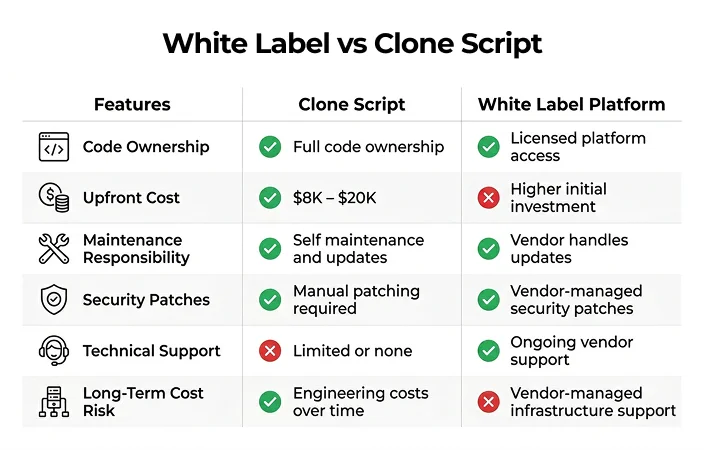
These two options get conflated constantly. They’re meaningfully different.
A clone script is a copy of an existing exchange codebase that you buy outright for a flat fee. You own the code. You deploy it on your own servers. You handle all maintenance, updates, and security patches yourself.
A white label platform is a licensed product you deploy and operate, usually with ongoing vendor support. You don’t necessarily own the underlying code, but you get continuous updates, security patches, and technical support included.
Clone scripts cost less upfront, often $8,000 to $20,000. But one team we know spent $60,000 in engineering time over 18 months maintaining a clone script they bought for $12,000. They didn’t save money. They just delayed their costs.
White label platforms cost more upfront but shift ongoing risk to the vendor. If there’s a critical security vulnerability in the matching engine, the vendor patches it.
Learn more about crypto exchange solutions and pricing at Crypto Exchange Clone Script.
How to Evaluate a Provider Before You Sign Anything
Most founders evaluate providers by reading feature lists. That’s not enough.
- Ask for uptime records. Any provider worth working with can show you 99.9% uptime SLA documentation and actual historical uptime data.
- Request a live admin panel demo, not a video. A live session where you click around the admin interface yourself.
- Test the withdrawal flow on their demo environment. Initiate a withdrawal and time it. Ask what happens if a withdrawal gets stuck.
- Ask specifically about liquidity. Where does it come from? What’s the minimum spread on BTC/USDT during low-volume hours?
- Get references. Ask for clients who launched in the last 18 months and contact them directly.
Monetization: How Your Exchange Makes Money
Most founders focus entirely on building the exchange and forget to model out the revenue. Here are the four main income streams.
Trading fees are your primary revenue driver. The standard is 0.1% to 0.25% maker/taker fee per trade. On $500,000 in daily trading volume, that’s $500 to $1,250 per day, or $15,000 to $37,500 per month.
Listing fees apply when project teams pay to get their token listed. Reputable exchanges charge $5,000 to $50,000 per listing. This works only once you have real user volume and liquidity depth.
Withdrawal fees are flat fees per withdrawal. Common rates are $1 to $5 for stablecoin withdrawals. These add up consistently once your user base grows.
Staking and yield products are increasingly common. You partner with protocols to offer yield to users, take a spread of 10% to 20% of the yield generated, and the user gets the rest. It improves retention significantly.
Don’t model profitability on listing fees alone. We’ve seen multiple exchange founders build their entire financial plan around listing fees before they had any users. That model collapses quickly. Build trading volume first. Everything else follows.
FAQ
What is white label crypto exchange software?
It’s a pre-built, rebrandable trading platform that includes a matching engine, user dashboards, admin tools, wallet integrations, and compliance modules. You license it, apply your branding, and launch it as your own exchange without writing the core infrastructure from scratch.
How much does a white label crypto exchange cost in 2026?
Upfront licensing or purchase fees run between $15,000 and $60,000. Factor in another $10,000 to $25,000 for third-party integrations, legal setup, and cloud infrastructure. Total year-one budget is typically $40,000 to $100,000.
How long does it take to launch a white label crypto exchange?
Realistically, 10 to 16 weeks for a fully tested, compliance-ready exchange. Vendors will quote 2 to 4 weeks, but that doesn’t include KYC provider onboarding, payment gateway verification, or proper security testing.
Do I need a license to run a crypto exchange?
Yes, in most jurisdictions. EU-based exchanges need VASP registration under MiCA. US-facing platforms require FinCEN MSB registration and potentially state money transmitter licenses. Budget $5,000 to $25,000 for legal setup.
What’s the difference between white label and clone script?
A clone script is a one-time code purchase you own and maintain yourself. A white label platform is a licensed product with ongoing vendor support and security patches. Clone scripts are cheaper upfront but can cost more in long-term engineering maintenance.
Can I customize a white label exchange platform?
Yes, but with limits. Branding, UI themes, fee structures, and supported trading pairs are always customizable. Deep changes to the matching engine or core architecture usually aren’t without a custom development engagement.
How does liquidity work on a new exchange?
Most white label platforms connect your exchange to external liquidity providers via API so your order books aren’t empty from day one. You still need to attract your own traders over time to build organic volume.

