The average custom-built crypto exchange takes 12 to 18 months and costs between $200,000 and $500,000 before you see a single trade. A white label exchange script, by contrast, can go live in 3 to 8 weeks. That gap is why hundreds of founders are choosing the script route in 2026. But a lot of them are making the same costly mistakes: picking the wrong vendor, underbudgeting for compliance, and launching without proper liquidity.
This guide walks you through what a crypto exchange script actually is, how it works, what it really costs, and how to avoid the pitfalls that kill most exchange startups in their first year.
What Is a Crypto Exchange Script, Exactly?
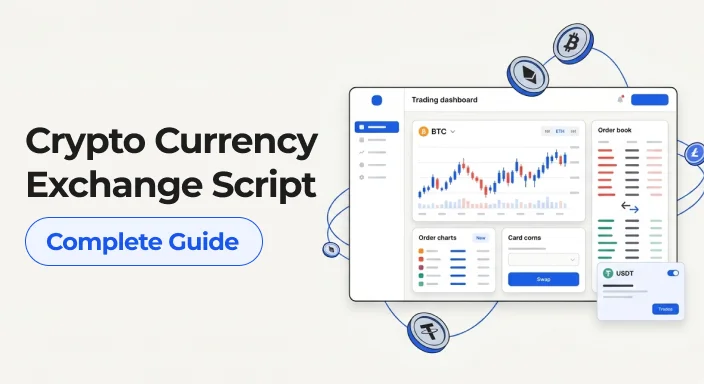
A crypto exchange script is packaged software. You’re buying a working codebase, not a concept. The script includes the trading engine, user registration system, wallets, order book, admin dashboard, and security layers already built and tested. You customize the front end, add your branding, connect your payment processors, and launch.
Think of it the way you’d think of a SaaS boilerplate. You don’t write authentication from scratch when you build a product on top of Node.js. You install a package, configure it, and ship. A crypto exchange script does the same thing for trading infrastructure.
The key distinction: a script is not a live platform. It’s the foundation. You still need hosting, a compliance setup, liquidity connections, and a team to operate the platform after launch. Vendors who sell scripts as “plug and play with zero effort” are oversimplifying. There’s always integration work.
We’ve seen founders spend $30,000 on a script and another $40,000 on the integrations, hosting, and KYC provider they didn’t budget for. That surprise hits hard six weeks before launch.
How a Crypto Exchange Script Works Under the Hood
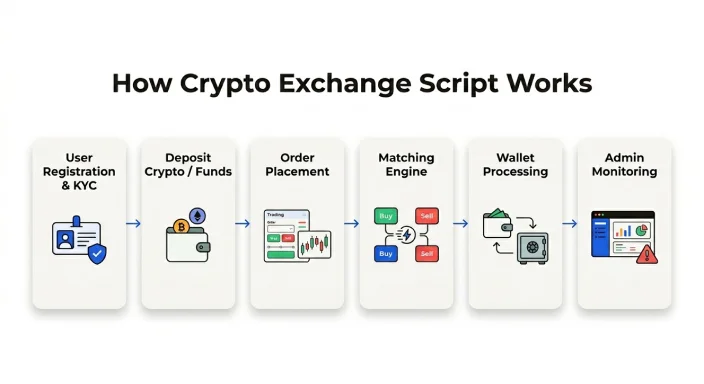
A crypto exchange script has several technical layers that have to function together without breaking.
The matching engine is the core. It receives buy and sell orders, matches them based on price and time priority, and executes trades in milliseconds. Most quality scripts use Node.js for the matching engine because of its event-driven architecture and raw throughput. One client ran their matching engine on a shared server. At 200 concurrent users, it started lagging. At 400 users, trades were executing 4 to 6 seconds late. Don’t underestimate how much compute this layer actually needs.
Wallets are separate from the matching engine. Hot wallets hold a small portion of user funds for instant withdrawals, typically 5 to 10% of total holdings. The rest goes into cold storage. BitGo and Fireblocks are the two providers most commonly integrated for cold storage and multi-signature key management. Don’t build your own key system. It sounds like a cost-saving move. It isn’t.
The KYC layer sits at the front of the user flow. On registration, users submit identity documents. The module calls an external provider (Sumsub and Jumio are the most common), verifies identity, and flags risk levels automatically. This is non-negotiable in most jurisdictions. If your vendor doesn’t have this built in, that’s a red flag.
The admin panel ties everything together: fee management, user moderation, withdrawal approvals, liquidity monitoring, and transaction flagging. A good admin panel prevents 3am emergencies. A bad one causes them.
White Label vs Custom Development: The Real Decision
This is where most founders get it wrong. They either dismiss white label as “not serious enough” or assume custom is too expensive and skip features they actually need.
White label scripts cost between $15,000 and $50,000. You get a working platform in 3 to 8 weeks. You have limited control over core architecture, and you’re dependent on the vendor for major updates.
Custom builds start around $150,000 and can climb past $400,000 for a full-featured exchange with margin trading and derivatives. Timeline is 10 to 18 months. You own every line of code.
The question isn’t which is better. The question is: what do you need to validate your business model? If you need to test a market, prove user demand, and generate early revenue, white label is the faster and smarter path. If you’re building a regulated exchange for institutional clients and need specific margin products or proprietary matching logic, you’ll need custom development eventually.
One exchange we worked with launched a crypto exchange clone script in 8 weeks, processed $2 million in volume in their first quarter, and used that proof of traction to raise capital for a custom rebuild 14 months later. That’s the right sequence. Script first, custom second.
What a Crypto Exchange Script Actually Costs in 2026
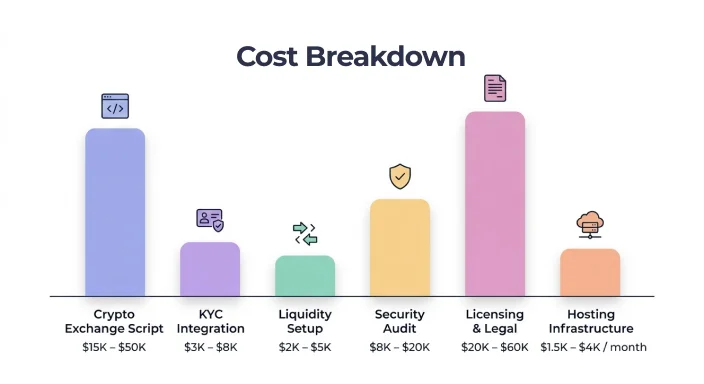
Here’s the breakdown most vendors won’t give you upfront.
The script itself runs $15,000 to $50,000 for a white label solution. Some vendors require full payment upfront; others split it across milestones. Always negotiate milestone-based payments so you can walk away if delivery quality drops.
KYC integration: Sumsub charges roughly $0.50 to $2.00 per verification depending on volume. Budget $3,000 to $8,000 for initial integration work plus ongoing per-verification costs at scale.
Liquidity setup is often the most underbudgeted item. Connecting to a provider like B2Broker or Modulus typically involves $2,000 to $5,000 in setup fees plus monthly minimums. Some providers charge a spread on executed volume on top of that.
Security audit: don’t skip this. A third-party penetration test before launch runs roughly $8,000 to $20,000. One team we advised skipped the audit to cut costs, launched, and had a hot wallet exploit 40 days later. They lost $180,000 in user funds and shut down three months after that.
Licensing depends heavily on your jurisdiction. A Money Services Business registration in the US costs a few hundred dollars in filing fees but requires state-level licenses in most states, which adds up fast. A full VASP license in the EU or Estonia can cost $20,000 to $60,000 in legal fees alone, and some jurisdictions take 6 to 12 months just for approval.
Hosting runs $1,500 to $4,000 per month on AWS or GCP at modest scale. At high volume, you’ll exceed $15,000 monthly on infrastructure.
The realistic total to properly launch a white label exchange: $80,000 to $150,000 all-in. Not $15,000. Any vendor quoting you $15,000 as a total cost is selling you the script price, not the launch cost.
Core Features Your Script Must Have Before Launch
Not all features matter equally. Some you need on day one. Some can wait.
Day-One Requirements
The trading engine has to handle your expected concurrent users with headroom to scale. Test it before launch with simulated load. Matching speed under 50 milliseconds is the baseline for a credible exchange in 2026. Anything slower and you’ll see user complaints within the first week.
Multi-currency wallet support across at least Bitcoin, Ethereum, USDT, and BNB should come standard. If you’re launching a niche exchange for a specific token ecosystem, adjust your list accordingly, but don’t launch with a single-currency wallet.
KYC/AML is mandatory in most markets before you process a single transaction. Jurisdictions are tightening, not loosening. Don’t launch without it.
A working admin panel with real-time monitoring. Some vendors ship scripts with admin panels that look functional in demos but break under real traffic. Ask for a sandbox demo with live-simulated data before purchasing. If they won’t show you a live demo, that tells you something.
Features That Can Wait
Margin trading, futures, staking, copy trading, and mobile apps are roadmap items. Launch with spot trading, get users onto the platform, generate revenue, and expand from there. Founders who try to launch with every feature end up shipping nothing, or shipping something too slow to compete.
How to Launch Your Exchange: Step by Step
First, choose your jurisdiction and start the licensing process before you write a single line of code. Licensing takes longer than development. This is consistently where founders lose 3 to 6 months by starting too late.
Second, select your vendor carefully. Ask for GitHub access or a code review before full payment. Ask specifically about the matching engine architecture and what load it’s been tested at. Ask who else is running their script in production and actually call those references.
Third, set up your infrastructure on dedicated cloud instances. Don’t share compute between your matching engine and your web server. They have entirely different performance profiles and will fight each other under load.
Fourth, connect your liquidity provider. Without liquidity, your order book is empty and users leave within minutes. Negotiate this during vendor selection, not after you’ve already paid.
Fifth, run your security audit. Fix every critical and high-severity finding before you open registration to the public.
Sixth, do a soft launch with a small invited user group. Watch logs for two weeks. Fix issues before a public announcement. Most exchange hacks happen in the first 90 days, during the window when operators are still learning the platform’s behavior under real conditions.
Full timeline for a white label launch done properly: 3 to 6 months. Anyone promising 2 weeks is cutting corners somewhere that will cost you later.
How Exchange Operators Make Money
The main revenue stream is trading fees. Most exchanges charge 0.1% to 0.5% per trade. At $10 million in daily volume, a 0.1% fee generates $10,000 per day in revenue. That’s the math that makes exchange businesses attractive to founders with enough capital to survive the first year.
Withdrawal fees are a secondary stream, usually set as a fixed amount per coin that covers network gas costs plus a small margin.
Listing fees apply when blockchain projects pay to have their token added to your platform. Early-stage exchanges with an active user base can charge $5,000 to $50,000 per listing depending on their reach and reputation.
Market making spread is less obvious but real. If you act as market maker on your own order book, you capture the spread between bid and ask. This requires capital and carries price risk, so most small exchanges skip it until they have a treasury to work with.
Premium accounts work as a subscription model. Some exchanges charge $99 to $299 per month for higher API rate limits, lower trading fees, and dedicated support. It’s not a primary revenue driver, but it adds a predictable monthly base to an otherwise volume-dependent business.
FAQ
What is a crypto currency exchange script?
A crypto currency exchange script is pre-built software that includes everything needed to run a trading platform: a matching engine, user wallets, KYC module, order book, and admin dashboard. It lets founders skip 12 to 18 months of custom development and launch in weeks instead.
How much does a crypto exchange script cost in 2026?
The script itself costs $15,000 to $50,000 for a white label solution. But the full launch cost, including KYC integration, liquidity setup, security audit, licensing, and hosting, typically runs $80,000 to $150,000. Founders who budget only for the script price almost always run short before launch.
How long does it take to launch using a crypto exchange script?
A properly executed white label launch takes 3 to 6 months. The script setup itself takes 3 to 8 weeks, but licensing, security auditing, liquidity provider integration, and soft launch testing add significant time. Anyone promising a fully compliant exchange in 2 weeks is skipping steps you’ll pay for later.
What’s the difference between white label and custom crypto exchange development?
White label gives you a working platform fast at $15,000 to $50,000, with limited architectural control. Custom development gives you full ownership starting at $150,000 with a 10 to 18 month timeline. Most successful exchange startups launch white label first, validate the business, then rebuild custom when they have the revenue to justify it.
Is a crypto exchange a profitable business?
Yes, when run correctly. At $5 million in daily trading volume with a 0.2% average fee, you’re generating $10,000 per day in gross revenue. The challenge is getting to that volume level. Most exchanges fail not because the business model is broken, but because they underestimate liquidity costs, compliance overhead, and user acquisition timelines.
What licenses do I need to run a crypto exchange?
It depends on your jurisdiction. In the US, you typically need Money Transmitter Licenses in each state you operate. In Europe, a VASP registration or full crypto exchange license is required in most markets. Estonia and Lithuania have historically been faster approval paths for EU licensing. Legal costs alone run $20,000 to $60,000 before accounting for ongoing compliance.
What questions should I ask a crypto exchange script vendor before paying?
Ask for a live sandbox demo with simulated traffic. Ask for the matching engine architecture and what load it’s been tested at. Ask for references from exchanges currently live on their script. Ask specifically about post-launch support terms, bug fix timelines, and whether you get source code escrow if the vendor shuts down. Any vendor who resists these questions is a vendor to avoid.

