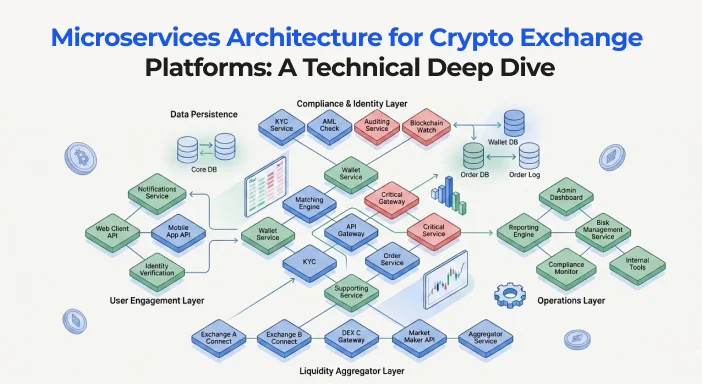
Why Your Exchange Architecture Is a Business Decision
Most crypto exchanges that fail don’t fail because of bad ideas. They fail because their infrastructure can’t scale past 50,000 daily active users. A monolithic codebase that worked fine at launch becomes a liability when trading volume spikes 10x in a single week. Binance processes over 1.4 million transactions per second. That number is only possible because their backend isn’t one system. It’s dozens of them, each handling exactly one job.
This is a technical guide, not a pitch deck. It covers how microservices architecture actually works in a crypto exchange context, which services matter most, and where the real engineering decisions live. If you’re a founder evaluating architecture options before committing to a tech stack, this is what you need to read.
Why Monolithic Exchanges Hit a Wall
The original architecture was straightforward: an API layer handling public requests, a matching engine for orders, and a sync module managing blockchain and banking integrations. This three-tier monolith works until it doesn’t.
One team we worked with built their exchange on a Node.js monolith. Everything in one repo, one deployment pipeline. When trading volume tripled during a bull run, the entire application had to scale. Not just the matching engine. Everything: user auth, email notifications, wallet queries, admin dashboards, KYC checks. They ended up paying for 12x infrastructure to handle 3x actual load. That’s not a performance problem. It’s an architecture problem.
In a monolith, a bug in the notification service can take down the trading engine. A memory leak in the KYC module slows order processing. You can’t update one component without redeploying the whole thing. Zero-downtime deployments become operationally painful. And because every feature is entangled with every other feature, technical debt compounds faster than revenue.
Microservices solve this by isolating failures and scaling only what needs scaling. The tradeoff is real though: you’re trading deployment simplicity for distributed system complexity. Teams that underestimate that overhead regret it around month six.
Core Services in a Crypto Exchange Microservices Stack
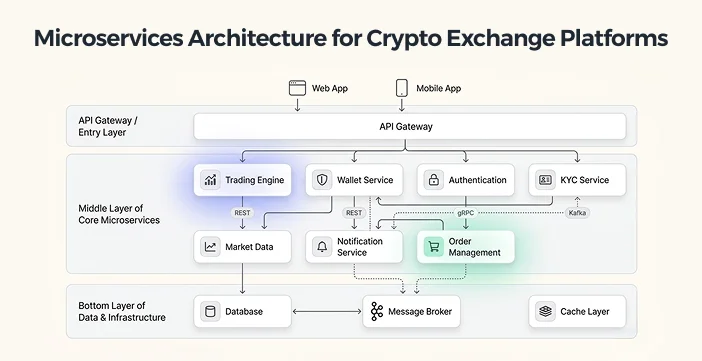
Getting service decomposition right is the single most important architectural decision you’ll make. Too granular and you have 200 services nobody can reason about. Too coarse and you’ve built a distributed monolith with none of the benefits and all of the pain.
For a production-grade crypto exchange, the core service split looks like this:
- Trading Engine Microservice: Order placement, matching, and cancellation. Your most performance-critical service. Built in Go or Rust, typically handling 50,000 to 200,000 orders per second depending on hardware. This is where latency matters in milliseconds, not seconds.
- Wallet Microservice: Hot and cold wallet operations, withdrawal queuing, and on-chain transaction tracking. Completely isolated from trade logic. A wallet vulnerability should never have a path to touch order execution.
- User Authentication Microservice: JWT issuance, OAuth2 flows, session management, and 2FA. One client had this mixed into their API gateway. When auth needed a security patch, they had to redeploy the gateway too. Separate it.
- Order Management Microservice: Order history, open orders, and trade records. Works well with CQRS (covered below).
- Market Data Microservice: Aggregates price feeds, computes OHLCV candles, and pushes real-time updates over WebSockets. This service alone handles thousands of concurrent socket connections during active markets.
- KYC/AML Microservice: Integrates with providers like Jumio or Onfido, runs document verification workflows, and flags suspicious activity. Separate from trading because KYC processing time should never block trade execution.
- Notification Microservice: Email, SMS, and push notifications. Lowest priority. If this goes down, trades still happen. Users just don’t get a confirmation email.
The principle: services that fail independently should be deployed independently. Never put wallet logic and notification logic in the same binary. Ever.
For exchanges handling institutional-grade trading volumes, you’ll also need a FIX Protocol Gateway microservice for algorithmic traders and a dedicated WebSocket service with its own scaling policy.
Inter-Service Communication: REST, gRPC, and Kafka
This is where most teams make expensive mistakes. The choice of communication protocol between services determines your system’s throughput ceiling.
REST over HTTP works for synchronous requests where the caller needs an immediate response. User authentication is the textbook example. When a user hits the trading API, you need to verify their JWT right now, not eventually. REST handles this fine.
gRPC is the better choice for internal service-to-service calls that need speed. Binary serialization via Protocol Buffers runs 3 to 10 times faster than JSON for high-throughput workloads. Your trading engine calling your order management service 50,000 times per second should use gRPC, not REST. The latency difference at that scale is the difference between a responsive platform and a slow one.
For asynchronous operations, Apache Kafka is the standard in serious exchange infrastructure. When an order fills, a Kafka event fires. The notification service picks it up and sends a confirmation. The trade history service records it. The portfolio service updates balances. None of this requires the trading engine to wait. It fires the event and moves on.
RabbitMQ is a reasonable alternative at lower throughput and it’s easier to operate. We use it in early-stage builds where Kafka’s overhead isn’t justified yet. Past 10,000 events per second, move to Kafka. The operational complexity pays for itself in reliability.
One mistake that comes up constantly: teams use HTTP calls for everything and wonder why their system slows under load. A Node.js service making five synchronous REST calls to downstream services on every trade execution adds hundreds of milliseconds of latency per request. On a trading platform, that’s a problem your users will notice immediately.
API Gateway Design and Security
Your API gateway is the single entry point for all external client traffic. It handles routing, rate limiting, authentication, and protocol translation before a single request reaches your internal services.
For a crypto exchange, the gateway enforces JWT validation on every inbound request. Rate limiting is non-negotiable: 429 responses protect your trading engine from scrapers, bot floods, and DDoS attempts. A reasonable baseline is 100 requests per minute for authenticated users, with tighter restrictions on withdrawal endpoints. One client skipped rate limiting on their withdrawal API during beta. They got hit with a scripted withdrawal spam attack within 72 hours of launch.
SSL termination happens at the gateway. Services behind it communicate over internal HTTP or gRPC, unencrypted, within a private network. Keeping TLS overhead off the hot path reduces latency across your internal call graph.
For zero-trust security between internal services, use short-lived service tokens issued by your auth microservice. Never let a service call another without validating identity. A team we worked with had no internal auth between their services. A vulnerability in their notification service exposed read access to wallet balance data. That’s the real consequence of treating your internal network as trusted by default.
JWT authentication between services, with tokens rotated every 15 minutes, adds maybe 2ms of overhead per call. It’s worth it.
Containerization and Orchestration with Docker and Kubernetes
Each microservice runs as a Docker container. The Dockerfile defines the runtime, dependencies, and startup command. This guarantees the service behaves identically across development, staging, and production. No more “it works on my machine” failures during deployment.
Kubernetes (K8s) handles orchestration: scheduling containers across nodes, restarting failed pods, and managing deployments. For a crypto exchange, the Horizontal Pod Autoscaler is critical. When market data traffic spikes during volatile price action, a common pattern, Kubernetes automatically provisions additional market data pods. When traffic drops, it scales back down. You’re only paying for what you actually need.
Zero-downtime deployments are the default with rolling updates. Kubernetes replaces pods one at a time, keeping the old version live until the new one passes its health checks. Blue-green deployment goes further by maintaining two complete environments and flipping traffic instantly. We recommend blue-green for trading engine updates, where any downtime window is expensive in user trust and trading fees.
Budget around $8,000 to $15,000 per month for a production-grade Kubernetes cluster on AWS EKS or GCP GKE at real exchange scale. A lot of early-stage teams underestimate infrastructure costs and scramble when live traffic arrives. Your CI/CD pipeline also needs to be in place before launch, not after: automated testing, container builds, and deployment pipelines should be running from day one.
Data Architecture: Database-Per-Service and CQRS
Each microservice owns its own database. The wallet service has a dedicated Postgres instance. The trading engine uses a high-throughput time-series database like TimescaleDB or ClickHouse. The market data service reads from Redis for sub-millisecond latency on live price feeds. The order history service might use a read-optimized data store tuned for range queries.
This is the database-per-service pattern. It prevents one service from querying another’s data directly, enforces proper service contracts through APIs, and lets each service pick the database that fits its workload. You’ll never get this right with a single shared database. A SELECT on order history shouldn’t be contending with wallet writes during peak trading.
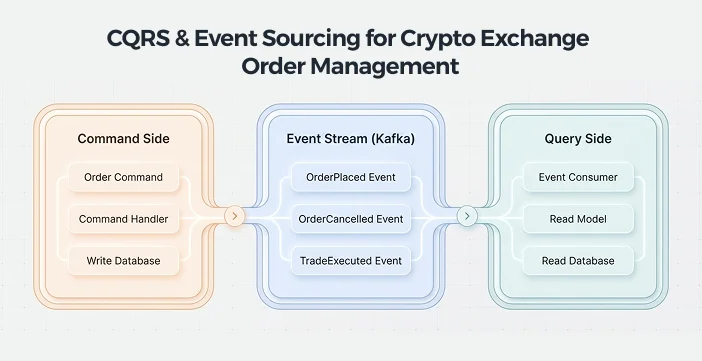
CQRS (Command Query Responsibility Segregation) fits naturally into order management. Write operations — place order, cancel order, fill order — go through a command handler that writes to the primary store and publishes a Kafka event. Read operations — fetch order history, active orders, trade records — query a separate read model optimized for display. This keeps write-heavy trade processing completely separate from query traffic.
Event sourcing pairs well with CQRS: instead of storing the current state of an order, you store every event that changed it. Full audit trail, point-in-time reconstruction, and a compliance team that doesn’t panic when regulators request transaction histories. One exchange we worked with had no event sourcing and needed to reconstruct 90 days of trade history after a data incident. It took three weeks and significant engineering time. Event sourcing would have made it a 10-minute query.
The real tradeoff: you can’t do a SQL JOIN across the wallet database and the trading database. Cross-service data needs are handled through API calls or event-driven replication. Teams used to relational monoliths find this adjustment harder than the containerization work.
Fault Tolerance and Circuit Breakers
In a distributed system, partial failure is normal. The goal isn’t zero failures. It’s failure that doesn’t cascade.
A circuit breaker prevents a slow or unavailable downstream service from taking everything else with it. The pattern: if your order service fails to reach the KYC service five times in a row, the circuit opens. Subsequent calls fail immediately with a fallback response rather than waiting on a 30-second timeout. After a configured interval, the circuit half-opens, lets one request through, and closes again if it succeeds.
For Java and Spring Boot services, Resilience4j handles this cleanly. Node.js teams use opossum. Go services usually implement circuit breaker logic directly given how lightweight it is in that ecosystem.
Health checks are the other half of fault tolerance. Every Kubernetes pod exposes a /health endpoint. Kubernetes hits it on a 10-second interval. A failing pod gets restarted. One that consistently fails gets pulled from the load balancer rotation. Your users see nothing. Monitoring with Prometheus and Grafana gives you the dashboard view: which services are degraded, which are recovering, and where latency is creeping up before users notice.
Distributed tracing with Jaeger or Zipkin ties the full picture together. A single trade execution touches five to eight services. Without tracing, debugging a slow request is guesswork. With tracing, you see the complete call graph and exactly which service added the latency. We’ve found performance regressions in under 10 minutes with good tracing in place. Without it, the same investigation took days.
Frequently Asked Questions
What’s the difference between microservices and monolithic architecture for crypto exchanges?
A monolith packages all exchange functions — trading, wallet, auth, notifications — into one deployable unit. If any component fails or needs to scale, the whole application is affected. Microservices separate each function into an independent service with its own codebase, database, and deployment pipeline. This allows independent scaling, isolated failure, and faster updates. The tradeoff is operational complexity: you’re now managing 10 to 20 services instead of one.
How much does it cost to build a crypto exchange on microservices architecture?
Development costs range from $150,000 to $500,000+ depending on team size, geography, and feature scope. Infrastructure on AWS or GCP runs $8,000 to $20,000 per month at production scale. A white label crypto exchange built on existing microservices architecture can cut that timeline by 60 to 70% — though you’ll hit customization ceilings faster than a custom build.
Which programming languages work best for crypto exchange microservices?
Go and Rust are the top choices for the trading engine and any latency-sensitive service. Node.js works well for API gateways, WebSocket services, and notification systems. Java with Spring Boot or Akka is common in order management and KYC pipelines. Python shows up in analytics and market data processing. The key advantage of microservices is polyglot development — each service picks the right tool for its job.
How do microservices handle high-frequency trading on crypto platforms?
The trading engine microservice is built for single-purpose throughput: receive orders, match them, emit fill events. Written in Go or Rust, it avoids garbage collection pauses and operates with sub-millisecond matching times. Kafka handles the async communication so the engine never waits on downstream services. At 50,000 to 200,000 orders per second, synchronous communication would be the bottleneck. Async event-driven design removes that ceiling.
What message broker should I use — Kafka or RabbitMQ?
RabbitMQ for early-stage builds: easier to operate, good enough for most pre-launch volumes. Kafka when you exceed roughly 10,000 events per second or need message replay capabilities. Kafka stores events durably and lets you replay them, which is useful for rebuilding read models or recovering from data issues. RabbitMQ deletes messages once consumed. For an exchange processing serious volume, Kafka is the right long-term choice.
Can I migrate my existing monolithic exchange to microservices?
Yes, but it’s not a weekend project. The most reliable approach is the strangler fig pattern: pull one service out at a time, starting with the lowest-risk candidates (notifications, KYC, market data). Keep the monolith running while the new service takes over its function. Once stable, extract the next service. Never try to rewrite everything at once. One team attempted a full-migration cutover in a single release and spent three months dealing with data consistency bugs afterward.
How do I keep data consistent across microservices in a crypto exchange?
You don’t use distributed transactions — they’re slow and fragile. Instead, design for eventual consistency through event-driven architecture. When a trade fills, the trading engine publishes a Kafka event. Downstream services (wallet, portfolio, notification) consume it and update their own state. For operations requiring strong consistency — like wallet withdrawals — use a saga pattern where each step in the workflow can be compensated if a later step fails. It’s more design work upfront, but far more reliable at scale.

