Most crypto exchange founders don’t plan to serve institutional clients on day one. But most also don’t plan to explain to a $200M hedge fund why their withdrawal took 45 minutes and why their 500 BTC limit order moved the market by 3%. If institutional flow is anywhere on your five-year roadmap — and for most serious exchange operators it should be — the architecture decisions you make at launch determine whether that door stays open. This guide explains what an institutional-grade trading engine actually is, which components matter most, and what’s realistic to build into a white label exchange versus what requires custom infrastructure from the ground up.
What “Institutional-Grade” Actually Means
The phrase gets used on a lot of landing pages to mean very little. Here’s what it actually requires.
An institutional-grade exchange is one that can serve hedge funds, asset managers, proprietary trading desks, and quantitative funds without those clients experiencing latency, slippage, or compliance friction that a retail platform would tolerate but they won’t. The bar is set by their alternatives: CME, Nasdaq, and tier-one crypto venues like Coinbase Prime and Binance Institutional.
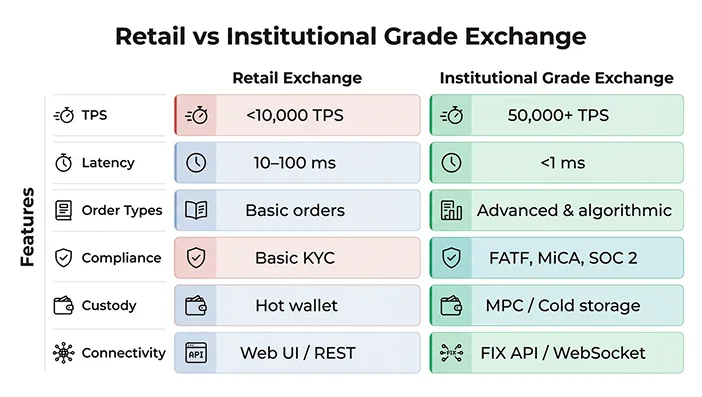
Practically, that means five things. The trading engine processes at least 50,000 transactions per second (TPS) with order acknowledgement latency under 1 millisecond. The order book supports block trades and algorithmic execution without visible price impact. The compliance infrastructure meets FATF Travel Rule requirements, MiCA standards if you’re operating in Europe, and SOC 2 Type II certification for operational security. Custody is MPC-based or multi-signature cold storage, not a standard hot wallet. And the connectivity layer includes FIX API and WebSocket feeds, because institutional algorithms don’t use browser interfaces.
You don’t need all of this on day one. But you do need to know which of these your current architecture can grow into and which it can’t.
The Order Matching Engine: Where Performance Gets Decided
The matching engine is the core of any exchange. It’s the system that pairs buy and sell orders and determines execution price and sequence. For retail traffic, a matching engine that handles 5,000 to 10,000 TPS is sufficient. Most retail users don’t notice a 10-millisecond order acknowledgement. Institutional clients do.
A quant fund running an arbitrage strategy between your exchange and another venue has a profit window measured in microseconds. If your matching engine takes 50 milliseconds to acknowledge an order, that strategy doesn’t work on your platform. They don’t complain. They just don’t come back.
The technical benchmark for institutional-grade matching is at minimum 50,000 TPS with sub-millisecond acknowledgement on co-located infrastructure. The leading institutional venues process over 1 million TPS. You don’t need to match Binance at launch, but you do need an engine architected in a way that scales there. An engine built on a relational database with synchronous writes won’t get there regardless of hardware upgrades.
In practical terms this means the engine runs in memory, not on disk. Order state is maintained in a high-speed in-memory data structure. Writes to persistent storage happen asynchronously. The engine is single-threaded for deterministic sequencing, which eliminates race conditions that would otherwise corrupt the order book at high throughput.
For a Node.js-based exchange backend, the matching engine itself is typically written in C++ or Rust and called via a native module. That’s not a detail to sort out after launch.
Advanced Order Types Institutions Actually Use
Iceberg orders let a trader place a large order while showing only a small visible portion on the order book. A fund buying 1,000 BTC doesn’t want the market to see 1,000 BTC on the bid side — that information moves price before the order fills. Iceberg orders hide the true size, revealing it in tranches as each tranche executes.
TWAP (Time-Weighted Average Price) execution splits a large order across a defined time window to reduce market impact. An asset manager who needs to buy $10M of ETH over four hours uses TWAP to avoid moving price through aggressive single-order execution. This isn’t a feature most retail traders need. Every institutional desk does.
Fill-or-Kill (FOK) and Immediate-or-Cancel (IOC) orders serve algorithmic strategies that need certainty. An FOK order either fills completely at the specified price or cancels entirely — no partial fills, no residual order sitting open. That matters when an algorithm’s logic assumes a fully executed position before placing the next leg.
Stop-limit orders on institutional platforms need to be reliable under fast markets. On many retail exchanges, stop triggers fire late during high-volatility events because the matching engine can’t keep up. Institutional clients notice and they won’t trust a platform where stops don’t execute predictably.
Block trade support is separate from these order types but equally important. A block trade executes a large position off the public order book at a negotiated price, usually through an OTC desk. This keeps the institution’s size private and avoids price impact entirely. Offering block trade functionality — even informally through a relationship desk — is a meaningful differentiator for early institutional clients.
Pre-Trade Risk Controls: What Breaks First When Institutions Arrive
This is the section competitors consistently skip, and it’s the first thing that breaks when institutional volume hits a retail-grade exchange.
Pre-trade risk controls are checks that fire before an order is accepted into the matching engine. They exist to prevent a single trader, algorithm, or API key from creating a catastrophic position the exchange can’t manage. Without them, one misconfigured algo can submit 10,000 orders in a second, exhaust your order book, and crash your matching engine. We’ve seen this happen to exchanges that didn’t have rate limiters on their API.
The baseline pre-trade controls an institutional client expects: position limits per account, maximum order size per submission, maximum order value in a rolling time window, margin utilization checks before order acceptance, and circuit breakers that halt trading on a pair when price moves beyond a defined percentage in a short period.
Beyond these, institutional clients managing regulated funds need pre-trade reports that document their compliance with internal mandate limits. Your exchange’s pre-trade API needs to expose the position and exposure data that makes their OMS (Order Management System) checks possible.
Portfolio margining calculates margin requirements across correlated positions rather than treating each independently. A fund that’s long BTC spot and short BTC futures has significantly lower net risk than a fund that’s long BTC spot alone. Portfolio margining reflects that, reducing capital requirements and making your platform more capital-efficient for institutional use. Most retail exchange clone scripts don’t include this. It’s buildable, but it takes deliberate effort to add correctly.
Custody Infrastructure: MPC Wallets vs Cold Storage
Institutional clients will ask your custody question before they ask about features. Where are their funds? How are keys managed? What happens if a team member gets compromised?
Traditional cold wallet storage uses offline signing devices. Funds sit in wallets whose private keys have never touched an internet-connected device. Withdrawals require physical access to the signing hardware. This is secure but slow. Institutional clients running active trading strategies can’t wait 4 hours for a withdrawal to process through a manual cold wallet signing ceremony.
MPC (Multi-Party Computation) wallets solve this. Instead of a single private key, MPC splits key material across multiple parties using cryptographic protocols. No single party holds a complete key. Signing a transaction requires a threshold of parties to participate — typically 2-of-3 or 3-of-5. This happens programmatically, enabling fast automated withdrawals while maintaining the security property that no single point of failure exposes funds.
Providers like Fireblocks and Copper use MPC. Fireblocks supports automated withdrawal policies that enforce business rules: only allow withdrawals to pre-approved addresses, require dual approval above a set threshold, block transactions to sanctioned addresses automatically. These are features institutional compliance teams require, not features they appreciate.
BitGo’s multi-signature approach is an alternative. Multi-sig requires m-of-n signatures from hardware keys before a transaction broadcasts. It’s slightly slower than MPC automation but equally secure and carries a longer audit trail that some compliance teams prefer.
The honest advice: don’t build your own custody system. License Fireblocks, BitGo, or Copper and integrate it. Custody is not where a startup exchange builds competitive advantage. It’s where they inherit liability if they get it wrong.
The Compliance Stack Institutional Clients Require
Compliance isn’t a checkbox for institutional clients. It’s part of their due diligence when selecting a trading venue. They’ll ask for documentation before they onboard.
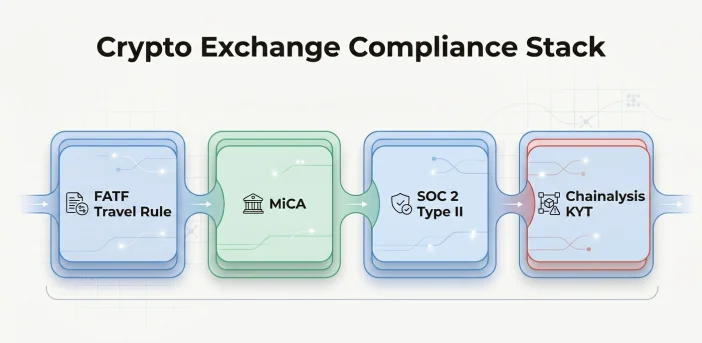
FATF Travel Rule. The Financial Action Task Force requires VASPs to share sender and recipient information for transactions above roughly $1,000. If your exchange can’t collect and transmit Travel Rule data, you can’t legally transact with compliant institutional counterparties in most jurisdictions. Travel Rule solutions like Notabene and Sygna integrate directly with your withdrawal flow and handle the data exchange protocol between VASPs.
MiCA (Markets in Crypto Assets). If you’re operating in the EU or serving EU-based institutions, MiCA compliance is now mandatory. MiCA covers licensing requirements, reserve requirements for stablecoin issuance, and market abuse rules. Institutional clients domiciled in the EU will ask for your MiCA status before trading. This isn’t optional from their perspective.
SOC 2 Type II. This auditing standard verifies that your security controls actually work over an observation period of 6 to 12 months. Hedge funds and asset managers routinely require SOC 2 Type II reports from their technology counterparties. Getting certified takes 9 to 18 months and costs $30,000 to $80,000. Start the process early if institutional business is in your roadmap.
Chainalysis KYT (Know Your Transaction). Transaction monitoring at the institutional level goes beyond basic KYC. Chainalysis KYT scores incoming and outgoing transactions against risk signals: known darknet market addresses, mixer activity, sanctioned wallet clusters. Institutional compliance teams need evidence that your exchange monitors for these risks in real time. KYT integration is a standard expectation, not a differentiator.
Learn how our crypto exchange clone script is architected to support institutional-grade compliance and trading infrastructure.
Can a Clone Script Be Made Institutional-Grade?
This is the practical question most founders don’t ask directly, but it’s the right one.
The honest answer is: partially, and it depends on which clone script vendor you’re working with.
The components that translate well from a clone script to institutional use are the compliance integrations (KYC/AML, Travel Rule, KYT), the order type set (iceberg, TWAP, and FOK can be added as modules), and the API connectivity layer (FIX API and WebSocket are buildable on top of a solid clone script backend).
What’s harder to retrofit is the matching engine itself. If your clone script uses a standard database-backed matching engine, getting it to 50,000 TPS requires a rebuild, not a patch. Most institutional exchange operators who started with a clone script eventually replaced the matching engine after reaching meaningful trading volume — typically around $5M to $10M in daily trading volume is where the limitations become operationally painful.
The right approach for a startup building toward institutional clients: launch on a clone script with solid compliance integrations and a capable API layer, target retail and semi-institutional users first, and plan a matching engine upgrade as a funded milestone at Series A or after reaching $5M daily volume. Don’t try to build an institutional matching engine on a startup budget before you have institutional clients to serve.
Frequently Asked Questions
What is the minimum TPS required for an institutional-grade exchange?
The practical minimum is 50,000 TPS with sub-millisecond order acknowledgement. Most institutional clients run algorithmic strategies that require predictable, fast execution. Below 10,000 TPS with latency above 5 milliseconds, quant funds and HFT desks won’t build strategies on your platform.
What is a FIX API and why do institutional traders need it?
FIX (Financial Information Exchange) is a messaging protocol used across institutional financial markets since the 1990s. Institutional algorithms, OMS platforms, and prime brokerage systems communicate via FIX. If your exchange doesn’t support FIX API connectivity, institutional traders have to build custom adapters, which most won’t bother with. FIX is non-negotiable for any exchange targeting professional trading desks.
What’s the difference between MPC wallets and cold wallets for exchanges?
Cold wallets store private keys on offline hardware and require manual signing — withdrawal processing can take hours. MPC wallets split key material cryptographically across multiple parties with no single point of failure. Signing happens programmatically, enabling fast automated withdrawals with institutional-grade security. Most institutional-focused exchanges use MPC for active trading funds and cold storage as a backup layer.
What is the FATF Travel Rule and does my exchange need to comply?
The FATF Travel Rule requires VASPs to collect and transmit originator and beneficiary information for transactions above $1,000. If your exchange processes withdrawals to other VASPs, you’re legally required to comply in most jurisdictions. Non-compliance creates liability and disqualifies you as a counterparty for compliant institutional clients.
How much does SOC 2 Type II certification cost for a crypto exchange?
SOC 2 Type II audits typically cost $30,000 to $80,000 depending on the size of your infrastructure and the auditor. The observation period runs 6 to 12 months before the report is issued. Most institutional clients won’t begin due diligence on a venue that doesn’t have at least a SOC 2 Type I in progress.
What is Chainalysis KYT and why do institutions require it?
Chainalysis KYT (Know Your Transaction) scores blockchain transactions against risk signals including sanctioned addresses, mixer services, and darknet market flows. Institutional compliance teams require evidence of KYT monitoring before selecting a trading venue. Without it, their internal compliance policies prevent them from depositing funds on your platform.
Can a white label crypto exchange support institutional clients?
Yes, with the right integrations and the right matching engine. Compliance modules (KYC, KYT, Travel Rule), advanced order types, and FIX API connectivity are all buildable on top of a solid white label exchange. The matching engine is the limiting factor — if your vendor’s engine caps below 20,000 TPS, you’ll need to replace it before serving active institutional desks.

