Every vendor in the clone script space will tell you two weeks. Some say seven days. One company’s homepage says 30 minutes. None of them are lying exactly — but none of them are giving you the full picture either. The deployment of a crypto exchange clone script can genuinely happen in two weeks. Going live with a platform that can hold user funds, handle real trading volume, pass a security audit, and stay on the right side of your jurisdiction’s regulations is a different thing entirely. This guide breaks down what the timeline actually looks like, what slows most founders down, and what you should have shipped before you call the platform live.
What “Ready in 2 Weeks” Actually Means
When a vendor says two weeks, they mean the technical deployment. That’s the server setup, the script installation, a skin applied to the UI, and a basic smoke test. You get a working order book, a login page, and a wallet interface.
What you don’t get in two weeks: a liquidity provider connected and seeded, KYC and AML flows tested with real document types, a security penetration test completed, a regulatory opinion from a lawyer, or a mobile app submitted to the App Store.
We worked with a founder who launched in 11 days, announced it publicly, and had to shut down four days later because their withdrawal queue broke under concurrent requests. The script worked. The exchange didn’t. The difference between a deployment and a launch is the part that takes the remaining four to six weeks.
So when you’re planning your timeline, separate these two things clearly. Deployment gets the product on a server. Launch means the platform can handle real users, real funds, and real risk.
Phase-by-Phase Launch Timeline for a CEX Clone Script
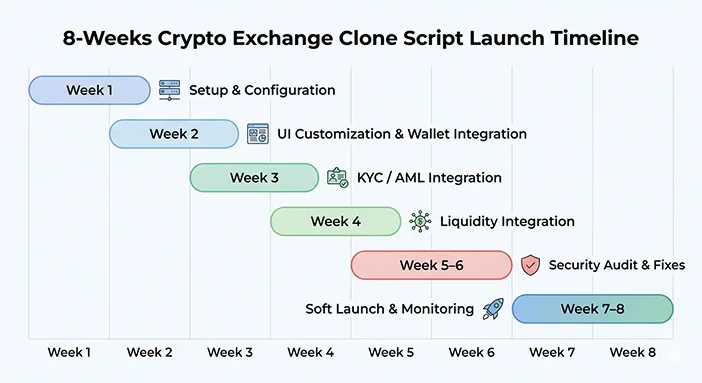
Here’s what a standard centralized exchange build actually looks like across 6 to 8 weeks when done properly.
Week 1: Setup and Configuration. The vendor installs the script on your chosen cloud infrastructure (AWS, GCP, or a VPS), configures the database, sets up the trading engine, and deploys the admin panel. You finalize your branding assets, domain, and coin listing for launch. Most of this is vendor-side. Your job is to have decisions made before this week starts, not during it.
Week 2: UI Customization and Wallet Integration. Your UI skin gets applied. Multi-currency hot wallet is configured. Blockchain node connections are established for each chain you’re supporting at launch. If you’re launching with BSC and Ethereum, both need live node connections and tested deposit/withdrawal flows. This is also when you configure the order matching engine parameters, set your trading fee structure, and set up the admin dashboard with your revenue rules.
Week 3: KYC/AML Integration and Testing. Providers like Sumsub or Onfido get integrated. Document verification flows are tested across passport types, driving licences, and ID cards from your target markets. This typically takes 5 to 8 days on its own. Don’t rush it. A KYC flow that rejects legitimate users at onboarding is one of the fastest ways to lose your early adopter base.
Week 4: Liquidity API Connection and Order Book Seeding. Your liquidity bridge gets connected and tested. This week also covers load testing the order matching engine under simulated volume. You want to confirm the engine holds under 200 to 300 concurrent orders before you invite real users in.
Week 5 to 6: Security Audit and Bug Fixes. A third-party penetration test runs across your web app, API endpoints, wallet withdrawal logic, and admin panel. Expect 8 to 15 critical and medium findings on a first audit. Every finding gets fixed, retested, and signed off. Budget 7 to 14 days for this phase. Vendors who skip this step are not vendors worth working with.
Week 7 to 8: Soft Launch and Monitoring. You open to a limited user group of 50 to 200 users and monitor transaction flows, withdrawal processing times, order matching latency, and API response under real load. Fix what breaks. Expand access only after 72 hours of stable operation.
CEX vs DEX vs P2P: How Exchange Type Changes Your Timeline
Not all clone scripts take the same time. The exchange model you choose changes the timeline meaningfully.
CEX clone scripts (Binance, Bybit style) are the fastest to deploy because the architecture is centralized. No smart contracts to audit, no on-chain transaction delays to account for in your UI. A standard CEX clone runs 4 to 6 weeks from kick-off to soft launch.
DEX clone scripts take longer because of smart contracts. A Uniswap-style AMM or a dYdX-style perpetuals clone requires contract deployment on-chain, which is straightforward. What adds time is the audit. Every contract that holds user funds needs a third-party security review before you can go live. Credible audit firms like CertiK, Hacken, and Trail of Bits take 2 to 4 weeks depending on contract complexity and their queue. A DEX clone realistically runs 7 to 12 weeks end to end.
P2P exchange clones fall in between. The escrow logic and dispute resolution system require more careful QA than a standard CEX. Edge cases in P2P flows, where both parties dispute a transaction and funds sit in escrow, take longer to test reliably. Budget 5 to 8 weeks for a P2P build.
| Exchange Type | Minimum Timeline | Realistic Timeline | Main Delay Factor |
|---|---|---|---|
| CEX (Binance / Bybit) | 2 to 3 weeks | 5 to 7 weeks | Liquidity + KYC testing |
| DEX (Uniswap / PancakeSwap) | 4 to 5 weeks | 8 to 12 weeks | Smart contract audit |
| P2P (WazirX / Paxful) | 3 to 4 weeks | 6 to 9 weeks | Escrow QA + payment integrations |
| Hybrid (CEX + DEX) | 6 to 8 weeks | 12 to 16 weeks | Both audit and liquidity setup |
Building a hybrid? Add the delays from both columns.
The 5 Factors That Delay Most Launches
In our experience, the same five things push timelines past what founders planned.
1. Delayed decisions on coin listings. Your vendor needs your initial coin list to configure trading pairs, set up blockchain nodes, and configure the wallet. Founders who spend week two debating which 30 coins to list push every subsequent phase back by a week or more. Lock this list in before development starts.
2. Third-party API negotiation. KYC providers, liquidity bridges, and payment gateways all require account creation, identity verification for your company, and sometimes a compliance review of your business model. Sumsub and Onfido approvals typically take 3 to 7 business days. Liquidity providers like B2BX can take 2 to 3 weeks to onboard a new client. Start these applications the same week you sign your vendor contract.
3. UI revision cycles. Founders who didn’t finalize their brand identity before development started spend week two and three requesting design changes. Every revision cycle that touches the frontend delays backend integration testing. Come to the project with your logo, color palette, and UI wireframes already approved internally.
4. Hosting environment mismatches. Scripts are developed and tested in a specific environment. When you bring your own AWS setup with custom security groups, different Node.js versions, or a stricter firewall config, deployment breaks in ways that take 3 to 5 days to diagnose. Use the environment your vendor recommends for the first deployment.
5. Security audit findings. A first-time audit on a new exchange almost always surfaces 10 or more findings. Each one needs a fix, a regression test, and sign-off. Founders who schedule their launch announcement before the audit is done either delay the announcement or skip the fixes. Skip the fixes and you’re running a live exchange with known vulnerabilities.
Learn more about what’s included in a full-featured crypto exchange clone script before you start your build.
Regulatory Compliance: The Timeline Nobody Talks About
Every competitor article on this topic skips this section. That doesn’t mean you can.
If you’re launching in a regulated jurisdiction, your go-live date is not determined by your development vendor. It’s determined by your regulator. In the EU, a VASP registration under AMLD5 takes 3 to 6 months depending on the country. In the UK, an FCA crypto asset registration currently has a processing backlog of 6 to 12 months. In the UAE (ADGM or VARA), expect 3 to 6 months from application to approval.
Some jurisdictions are faster. Estonia’s VASP regime previously processed applications in 4 to 8 weeks, though requirements have tightened significantly since 2023. Seychelles and the Cayman Islands offer faster incorporation timelines but limited banking access as a trade-off.
The practical answer for most early-stage founders: launch in a jurisdiction where you don’t need a licence to operate a crypto exchange, apply for your licence in parallel with development, and migrate to full compliance once approved. Consult a crypto-specialist lawyer in your target jurisdiction before you assume this approach is available to you. It isn’t in every market.
Don’t start development without a clear answer on your regulatory position. A fully built exchange you can’t legally operate is not an asset.
Clone Script vs Custom Development: A Timeline Comparison
If you’re evaluating whether to use a clone script or build from scratch, here’s the honest timeline comparison.
| Factor | Clone Script | Custom Development |
|---|---|---|
| Basic deployment | 1 to 2 weeks | 4 to 6 months |
| Full launch ready | 5 to 8 weeks | 12 to 18 months |
| UI customization | 1 to 2 weeks | 2 to 3 months |
| Smart contract (DEX) | Prebuilt + audit | 2 to 4 months + audit |
| Post-launch flexibility | Limited (vendor dependent) | Full |
| Time to first revenue | 6 to 10 weeks | 14 to 20 months |
The argument for custom development isn’t speed. It’s long-term control. If you need a specific order matching algorithm, a proprietary risk engine, or deeply customized margin logic that no clone script supports, custom is the right path. If you need to generate revenue in the next 90 days and your feature requirements fit what a clone script delivers, the math is clear.
One exchange we worked with tried to split the difference. They took a clone script, stripped it down to its core, and rebuilt half the modules from scratch to get specific features. They ended up with 10 months of development time and a codebase neither the vendor nor their own team fully owned. That’s the scenario to avoid.
Read our complete guide to crypto exchange clone scripts to understand the full feature set before deciding.
Your Post-Launch Checklist
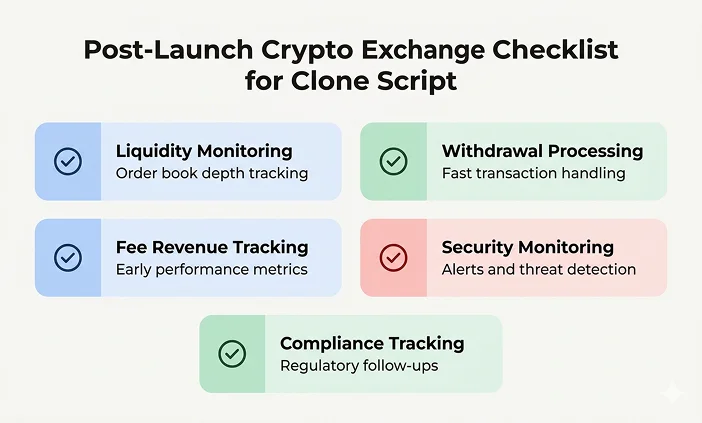
Going live is week eight. What comes next determines whether the platform survives its first 90 days.
Liquidity monitoring. Check your order book depth across all trading pairs every 24 hours for the first two weeks. Thin books on secondary pairs kill user retention fast. If a pair consistently shows less than $5,000 in depth on each side, delist it or reseed it.
Withdrawal processing time. Set an internal SLA: withdrawals should process within 30 minutes during peak hours. If you’re seeing consistent delays past 60 minutes, your hot wallet automation or blockchain node connection has a bottleneck.
Fee revenue tracking. Your trading fee revenue in the first 30 days tells you more about product-market fit than any other metric. If you have 200 registered users and total fee revenue under $200, your user acquisition or trading pair selection needs work, not your technology.
Security monitoring. Set up real-time alerts on failed login attempts, withdrawal requests above your threshold, and API rate limit breaches. These are the three most common early signals of an attack.
Compliance refresh. If you applied for a VASP licence during development, follow up with your legal team monthly. Regulatory timelines shift. Missing a deadline because you weren’t tracking it is avoidable.
Frequently Asked Questions
How long does it take to launch a Binance clone script?
A Binance clone script takes 5 to 8 weeks for a full launch-ready build in 2026. Technical deployment alone takes 1 to 2 weeks. Add 2 weeks for KYC and liquidity integration, 1 to 2 weeks for a security audit, and 1 week for a soft launch phase before opening to the public.
Can you really launch a crypto exchange in 7 days?
Technically, yes — you can have a script installed and an order book running in 7 days. But that’s deployment, not a launch. A platform ready to hold real user funds, process withdrawals safely, and pass a security audit takes 5 to 8 weeks minimum.
How long does a DEX clone script take vs a CEX clone script?
A DEX clone takes 3 to 5 weeks longer than an equivalent CEX clone, primarily because smart contracts require an independent security audit before going live. That audit alone takes 2 to 4 weeks with a credible firm. Budget 8 to 12 weeks for a DEX end to end.
What’s the single biggest cause of launch delays?
Regulatory and third-party API timelines. KYC provider onboarding, liquidity bridge approvals, and legal opinion letters all operate on the provider’s timeline, not yours. Start all three the same week you sign your vendor contract.
Does adding a mobile app extend the timeline?
Yes, by 2 to 4 weeks. Android and iOS apps need separate QA cycles, and App Store submission for a financial app takes 5 to 10 business days if Apple requests additional review. Submit your iOS app while your security audit is running, not after.
How long does VASP licensing take?
It depends on your jurisdiction. EU VASP registration ranges from 6 weeks in some Baltic states to 6 months in Germany or France. UK FCA registration has a backlog of 6 to 12 months. UAE (VARA) runs 3 to 6 months. Start your application the same month you start development.
Is a clone script or custom build faster for a regional exchange?
A clone script is always faster for a regional exchange. Custom development makes sense when you need proprietary risk management logic or a specific local payment rail no clone script supports. For a standard regional CEX, a clone script gets you live 8 to 12 months sooner.

