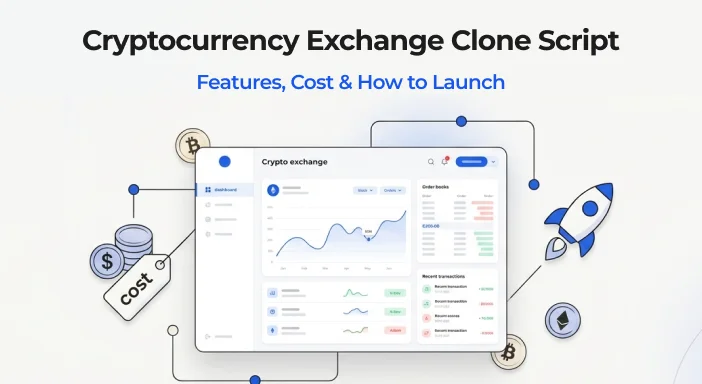
Binance processes over $20 billion in daily trading volume. Your users don’t know — or care — how the matching engine was built. They care whether their orders execute fast, withdrawals are reliable, and the interface doesn’t confuse them. That’s the logic behind cryptocurrency exchange clone scripts: if the architecture works at scale, starting from a proven template beats building from zero.
But clone scripts come with real constraints most vendors won’t tell you upfront. This guide covers what a clone script actually includes, what it genuinely costs in 2026, and the specific sequence you need to follow from purchase to a live, compliant platform.
What a Clone Script Actually Is (vs a Generic Exchange Script)
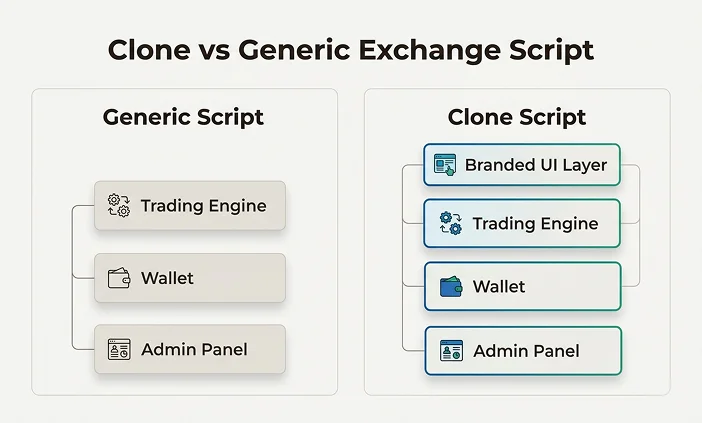
A clone script is more specific than a generic exchange script. A generic script gives you the infrastructure to run an exchange. A clone script gives you infrastructure designed to mirror a particular exchange — Binance’s UI patterns, KuCoin’s trading pair structure, Coinbase’s onboarding flow.
That distinction matters more than it sounds. When you buy a Binance clone, you’re getting a UI layout that your users will immediately recognize. The order book looks familiar. The charting interface behaves the same way. That reduces user friction on day one, which is the hardest problem any new exchange faces.
So: Clone = generic trading infrastructure plus a matched user experience borrowed from a specific, proven platform.
What it isn’t: a copy of Binance’s codebase. Vendors build these scripts independently, modeling the UX and feature set without copying proprietary code. The matching engine is their own implementation. The interface is visually inspired, not lifted.
One thing we’ve seen founders misunderstand: they assume the clone is legally identical to its source. It isn’t. But the closer your interface is to Binance or Coinbase, the more you need to think about brand differentiation from day one. Launching a platform that looks exactly like Binance isn’t a strength. It’s a positioning problem. Your clone should be a starting point, not your finished product.
For a full breakdown of available options, see: cryptocurrency exchange clone script.
The Feature Stack: What You Get and What You Don’t
Clone scripts come with a standard layer of trading infrastructure that any real exchange needs. Here’s what that actually looks like at the code level.
Matching Engine
Processes buy and sell orders and executes trades based on price-time priority. Node.js is the most common implementation because it handles concurrent connections efficiently. Quality varies significantly between vendors. The benchmark you’re looking for: order matching under 50 milliseconds at 500 concurrent users. Ask vendors for test data, not promises.
Multi-Currency Wallet System
Hot wallets hold a working balance for instant withdrawals, typically 5 to 10% of total funds. Cold storage handles the rest. BitGo is the most common third-party integration for multi-signature cold storage. Don’t build your own key management. We’ve seen that go badly enough times that it’s worth repeating.
Order Book and Trading Pairs
Spot trading pairs come pre-configured. Most Binance clone scripts ship with BTC, ETH, USDT, and BNB pairs as defaults. Adding new pairs post-launch is a configuration change, not a development task, on quality scripts.
KYC/AML Module
Registration flows, document upload, identity verification via Sumsub or Jumio, and risk-scoring for transaction monitoring. Without this, you can’t legally operate in most markets. With a poorly implemented version, you’ll fail your first compliance audit.
Admin Panel
User management, fee controls, withdrawal approval queues, liquidity monitoring, and reporting. This is where your day-to-day operations live. A weak admin panel creates manual work that doesn’t scale.
What You Don’t Get
Proprietary matching logic. Margin trading and futures aren’t standard in most clone scripts — they’re paid add-ons that need separate compliance treatment in almost every jurisdiction. Budget an extra $10,000 to $25,000 and get legal advice before enabling them.
Clone Script Types and Which Fits Your Business
Not all clone scripts target the same audience. Choosing the wrong base model creates rebranding work that costs more than getting it right the first time.
Binance Clone Script
Built for high-volume trading with spot, futures, and P2P modules. Best for founders targeting experienced traders or planning to list a wide range of token pairs. The admin tooling is deep. The compliance requirements are also the heaviest — Binance-modeled platforms attract regulatory attention in most markets.
Coinbase Clone Script
Simplified onboarding, clean UI, fiat integration-first. Best for founders targeting crypto newcomers or operating in regulated Western markets. You’ll spend less on UI work post-purchase. You’ll spend more on licensing because the Coinbase model implies regulatory seriousness.
KuCoin Clone Script
Mid-range complexity, strong on futures and margin modules. Good for startups targeting intermediate traders. API access for algo traders is usually more developed in KuCoin-based scripts than in simpler alternatives.
P2P Clone (Paxful / Remitano Model)
No order book matching. Users post buy/sell ads and transact via escrow. Lower infrastructure cost, lower liquidity requirement. Useful for markets with limited banking access where P2P has strong product-market fit.
What It Honestly Costs in 2026
Here’s the full breakdown, including the items most vendor quotes leave out.
The script itself: $10,000 to $50,000 depending on clone type and vendor. Binance clone scripts with full futures modules sit at the top of that range. Simple CEX-only scripts start around $10,000 to $15,000. Always structure payment in milestones — 30% on contract, 40% on delivery of a working dev environment, 30% on staging sign-off.
KYC provider integration: Sumsub charges $0.50 to $2.00 per verification at typical startup volumes. Budget $3,000 to $6,000 for the integration work on top of that.
Liquidity provider connection: B2Broker and Modulus are the two most common for new exchanges. Setup runs $2,000 to $5,000. Monthly minimums run $1,000 to $3,000. Without connected liquidity, your order book is empty on day one and users leave immediately. We’ve seen this exact failure more times than we’d like.
Security audit: $8,000 to $20,000 for a proper third-party penetration test. One team deferred their audit six months post-launch and found three critical vulnerabilities after processing $900,000 in user deposits.
Licensing: Estonia and Lithuania remain the fastest EU paths for VASP registration, typically $15,000 to $30,000 in legal fees with a 3 to 6 month approval timeline. US national operations can reach $50,000 to $150,000 across state-level Money Transmitter License applications.
Hosting: $1,500 to $4,000 per month on AWS or GCP for a startup-scale exchange. The matching engine needs dedicated compute — don’t share it with your API server.
Realistic total: $70,000 to $150,000 to launch properly. Any quote significantly below that is missing at least one critical line item.
The Hidden Risks No Vendor Mentions
Vendor Lock-In
Most clone script vendors don’t give you a clean, documented codebase. You get a working deployment with variable code quality. When something breaks post-launch, you’re calling them — at their rates, on their timeline. Get source code in escrow before you sign anything. This is non-negotiable.
Clone Fatigue
If your platform looks and feels exactly like Binance, you have no reason for users to choose you over Binance. You need distinct positioning — lower fees, a specific niche, or a feature Binance doesn’t offer your target user. Most founders skip this entirely and then wonder why user acquisition costs stay high.
Codebase Quality Variance
Two vendors can both sell Binance clone scripts and deliver entirely different code quality. One delivers a clean Node.js API with documented endpoints. Another delivers a tightly coupled monolith that breaks every time you change a UI color. The only way to verify before purchase: ask for a GitHub preview, hire a developer to review three or four key files, and walk away if they refuse.
Scalability Surprises
Clone scripts are tested at vendor conditions, not yours. Run load testing at 3x your projected day-one traffic before going live. Budget 3 to 5 developer days for this step. It’s almost always worth it.
How to Launch: The Correct Sequence
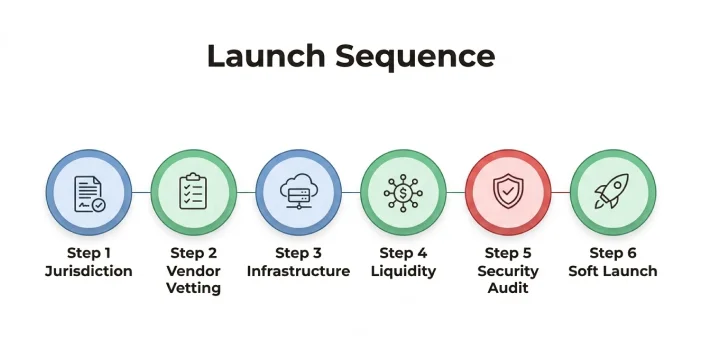
Most founders get the order wrong. They buy the script, then figure out licensing. That costs 3 to 6 months.
Step 1 — Choose jurisdiction first. Your licensing timeline determines your launch timeline. Start the application before you touch code. Estonia and Lithuania are the fastest EU paths. Offshore options (Seychelles, Caymans) are faster but limit your banking relationships significantly.
Step 2 — Vet your vendor. Ask for a working demo, a GitHub preview, and two active client references. Call those references. Ask specifically about post-launch support quality, not just the initial build. Negotiate source code escrow and milestone-based payment before signing.
Step 3 — Infrastructure setup. Dedicated cloud instances on AWS or GCP. Separate compute for matching engine, API layer, and database. Shared hosting on a clone script creates the worst kind of production problems.
Step 4 — Liquidity provider integration. Connect during development, not after launch. Test order book depth under simulated trading conditions. Thin books at launch mean users leave and don’t return.
Step 5 — Security audit. Third-party, not internal. Fix every critical finding and every high finding before opening registration to the public.
Step 6 — Soft launch. 50 to 200 invited users, two to three weeks of observation. Watch withdrawal queue behavior, order execution under load, and admin panel stability. Then open publicly.
Full timeline done properly: 10 to 16 weeks from vendor selection to public launch.
Making Money: Revenue Model for Clone Exchange Operators
Trading fees are the primary stream. Most clones default to a 0.1% to 0.2% maker/taker structure. At $5 million in daily volume, 0.15% generates around $7,500 per day. That math is why exchange businesses attract serious capital — but also why the first 6 to 12 months before meaningful volume are the hardest to survive financially.
Listing fees are underutilized by most small exchanges. With 2,000 to 3,000 regular traders, blockchain projects will pay to list on your platform. Typical range: $5,000 to $30,000 per listing depending on your volume and audience quality.
Withdrawal fees add a small margin on gas costs. Consistent and zero-cost to operate once configured.
API access tiers work well if you attract algorithmic traders. Charge $99 to $499 per month for higher rate limits and dedicated support. A small number of algo traders can generate more API revenue than hundreds of retail users combined.
Staking and yield products require a treasury management strategy and regulatory clearance. Don’t offer them until you have an advisor who has done it before.
FAQ
What is a cryptocurrency exchange clone script?
Pre-built software that replicates the trading architecture and UI of an established exchange like Binance or Coinbase. You get a working matching engine, wallets, KYC module, and admin panel without building those systems from scratch. The UI mirrors a known platform, which reduces user learning curve at launch.
How much does a crypto exchange clone script cost?
The script itself costs $10,000 to $50,000. Full launch including KYC integration, liquidity provider setup, security audit, licensing, and infrastructure typically runs $70,000 to $150,000. Any quote significantly below that is missing at least one critical line item.
How long does it take to launch a clone script exchange?
With proper compliance handling, 10 to 16 weeks. The script deploys technically in 3 to 6 weeks. Licensing, security auditing, and liquidity provider integration add the remaining time. Skipping those steps shortens your timeline but creates serious operational and legal risks.
What’s the difference between a clone script and a white label crypto exchange?
A clone script mirrors a specific exchange’s UX (Binance, Coinbase). A white label is a neutral, unbranded platform you customize from scratch. Clone scripts are faster to recognize for users; white label gives more differentiation from day one. Both need the same compliance and infrastructure work.
What are the biggest risks with clone scripts?
Vendor lock-in without source code access. Poor codebase quality that’s not visible until post-launch. No user-facing differentiation from the source exchange. And scalability gaps that appear under real trading load but weren’t tested during development.
Can I add margin trading to a clone script?
Yes, but it’s a paid add-on, not included in the base script. It also requires additional compliance treatment in most jurisdictions. Budget $10,000 to $25,000 extra and get legal advice before enabling it for users.
What should I ask a clone script vendor before paying?
Live demo with real order placement. GitHub preview or code sample. Two references you actually call. Support SLA and bug fix timeline post-launch. Source code escrow availability. Any vendor who resists these questions is a vendor to avoid.

