Over 65% of crypto exchanges that launched in 2024 ran on some form of white label infrastructure. That surprises most founders, who assume serious platforms are always built from scratch. The reality is that building a production-grade matching engine on Node.js that survives $2M in daily volume takes a minimum of 14 months — and that’s before you’ve written a line of KYC logic or configured a single fiat gateway.
The choice between white label and custom crypto exchange software isn’t about which is “better.” It’s a business architecture decision with long-term cost curves, IP ownership implications, and hard technical ceilings on both sides. Get it wrong in month one and you’re rebuilding in month 18. This guide gives you the actual numbers.
What You’re Actually Deciding
Most comparisons frame this as speed vs control. That framing is incomplete.
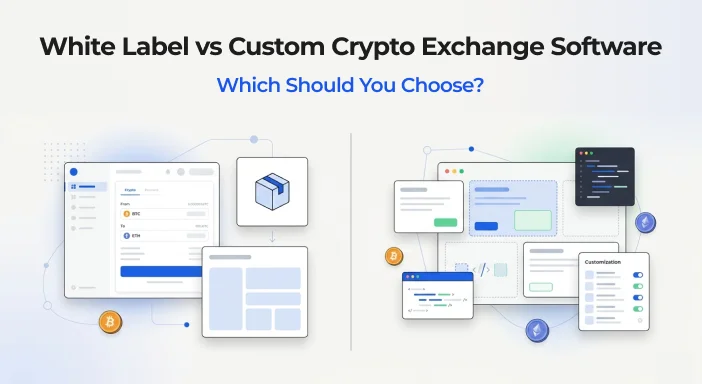
What you’re really choosing between is two different ownership structures. With white label, you license a pre-built exchange platform, customize branding and some functionality, and operate under your own name. The core codebase belongs to the vendor. Your feature roadmap depends on what they ship. Your uptime depends on their infrastructure.
Custom development means you commission a platform built on your stack — Node.js for the backend trading engine, Web3 libraries for blockchain integrations, Laravel for admin systems, and third-party APIs for KYC, fiat gateways, and liquidity feeds. You own the source code outright. Every architectural decision is yours, and so is every bug.
The right choice comes down to four variables: budget, launch timeline, customization depth, and your long-term trading product vision. None of those factors exist in isolation, which is why “just go white label” or “always build custom” advice consistently fails founders.
Real Cost Breakdown for Both Models
The headline numbers in most comparisons are white label: $30K–$150K, custom: $300K–$1M+. Those figures are real but incomplete.
White label actual year-one costs:
| Cost Item | Estimated Range |
|---|---|
| Licensing fee (upfront or monthly recurring) | $30K–$80K upfront / $3K–$8K/month |
| UI customization, branded flows, trading pairs | $10K–$40K |
| KYC/AML module setup (if not bundled) | $5K–$20K |
| Ongoing licensing and vendor support (annual) | $36K–$96K/year |
| Total year-one estimate | $75K–$200K |
Custom development actual year-one costs:
| Cost Item | Estimated Range |
|---|---|
| Engineering team (6–10 developers, 12–18 months) | $280K–$600K |
| Security audits and penetration testing | $15K–$40K |
| Infrastructure (cloud, CDN, matching engine hosting) | $24K–$60K/year |
| Compliance engineering and external legal review | $30K–$80K |
| Total year-one estimate | $350K–$800K+ |
The number founders consistently miss on white label is the recurring license. At $6K/month, that’s $72K in year one alone. Over three years you’ve paid $216K in licensing on top of your upfront setup cost. A custom-built exchange at $450K amortizes to about $150K/year over the same period, with no vendor pricing dependency.
One founder we worked with chose white label because the $55K upfront was inside their seed budget. Two years in, the vendor raised monthly fees by 35% and capped API call limits on the standard tier. Migrating was more disruptive than they’d budgeted for. Always model white label costs assuming license prices will increase by 20–30% in year two.
Time to Market: The Numbers Founders Underestimate
A white label exchange can go live in 6–12 weeks. That includes vendor onboarding, branding, liquidity configuration via API, KYC flow testing, and a basic QA cycle. Some providers deliver a functional staging environment in under two weeks.
Custom development is 12–18 months at minimum. Not because development teams are slow — because the matching engine alone is a hard engineering problem. A production-grade engine needs to handle at least 10,000 transactions per second. Drop below that ceiling and you’ll see order slippage during high-volume market events. Order slippage destroys user trust quickly, and recovery takes months.
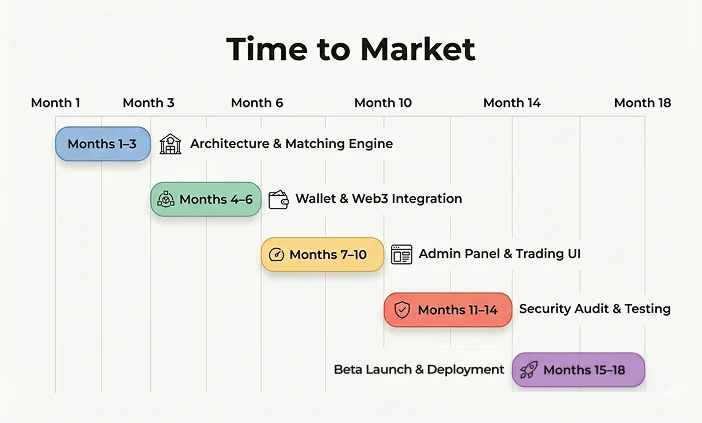
A realistic custom exchange build on Node.js and Web3 breaks down roughly like this:
- Months 1–3: Architecture design, database schema, matching engine core
- Months 4–6: Wallet infrastructure, Web3 integrations, fiat-to-crypto gateway APIs
- Months 7–10: Admin panel (
Laravel), KYC/AML module, trading UI - Months 11–14: Security audit, load testing, compliance sign-off
- Months 15–18: Beta launch, bug resolution, production deployment
If you’re responding to a market window — a jurisdiction that just cleared its VASP licensing framework, or a token listing opportunity — white label is the only realistic path. We’ve seen custom builds that started with a clear market opportunity in mind finish 14 months later to find two competitors already established and users already sticky to other platforms.
Source Code Ownership and Vendor Dependency
This is the question most founders don’t ask until it matters.
With a standard white label license, you don’t own the source code. You license the right to operate the platform. If the vendor shuts down, pivots their product line, or restructures pricing in a way that breaks your margins, your options are limited: renegotiate, accept the constraint, or rebuild from scratch.
Some vendors offer a “white label with source code” variant — a one-time fee, typically $80K–$200K, that delivers the full codebase with a right to modify and self-host. This is materially different from a standard license. You can fork it, customize the matching engine, and move it to your own infrastructure if needed. If your vendor offers this, it’s worth the premium for any platform expecting to operate beyond 18 months.
Custom development gives you full IP ownership from day one. Your Node.js codebase, your smart contracts, your admin panel logic — all of it is yours. If your dev team changes, you hire replacements without losing platform access.
Before signing any white label contract, ask three specific questions:
- What happens to our live platform if you discontinue or sunset this product?
- Do you offer source code escrow with an independent third party?
- Are there API rate limits or feature restrictions at any pricing tier?
If the vendor hedges on question one or can’t give a specific answer to question three, take that seriously. These are standard questions, and evasion on them is a signal.
Compliance in 2026: MiCA, VASP Licensing, and KYC/AML
Operating an unlicensed exchange in 2026 isn’t a gray area. The EU’s MiCA regulation is fully enforced. The UK FCA issues fines and public censures. Singapore’s MAS, UAE’s VARA, and Hong Kong’s SFC all have functional VASP registration frameworks with real consequences for non-compliance.
Both white label and custom exchanges require the same licenses. Your development model doesn’t change your regulatory obligations. What differs is how fast and how precisely you can satisfy the technical compliance requirements.
A white label platform with built-in KYC/AML modules saves roughly 3–6 months of compliance engineering and about $40K in external consultant fees. Most enterprise-grade providers now bundle automated transaction monitoring, FATF Travel Rule tooling, and sanction list screening into their base platform.
Custom development lets you architect compliance to your exact licensing jurisdiction. That precision matters if you’re targeting institutional clients or operating across multiple frameworks simultaneously. A retail KYC flow built for MiCA compliance won’t satisfy an FCA audit for a platform handling large-block institutional trades.
One exchange we worked with ran into this directly. Their white label KYC module handled retail onboarding cleanly under MiCA. When they tried to onboard corporate accounts — which required enhanced due diligence, source-of-funds documentation, and UBO verification — the vendor’s system didn’t support it. They spent $25K and six weeks building a custom workaround. It worked, but it added technical debt to a platform they didn’t control.
If your business model includes corporate or institutional accounts at launch, design your compliance architecture for that requirement from day one, regardless of which development model you choose.
The Hybrid Path: When It Works, When It Backfires
Some founders launch white label, validate product-market fit, then migrate to custom. The reasoning is sound. The execution is significantly harder than it sounds.
Migration means rebuilding your matching engine, wallet infrastructure, and user account system while keeping existing users live and trading. We’ve seen this process take 8–12 months and cost $200K–$400K, plus the operational risk of a live migration. In most cases, if you already know your product has real traction, starting with custom development is cheaper and less disruptive than migrating from white label at scale.
But the hybrid path works cleanly in one specific scenario: you launch white label as a genuine MVP with under 1,000 users, use that period to validate your trading pairs, fee model, and user acquisition channels, then rebuild on a custom stack before you scale past that threshold. Don’t attempt migration at 10,000 active users. At that scale, every hour of downtime has a cost and a reputational impact. Migrate at 500 users while your community is still small enough to be patient.
For a deeper look at what’s inside a white label platform before you commit, read our white label crypto exchange software buyers guide — it covers vendor evaluation, matching engine specs, and questions to ask before you sign.
Decision Framework
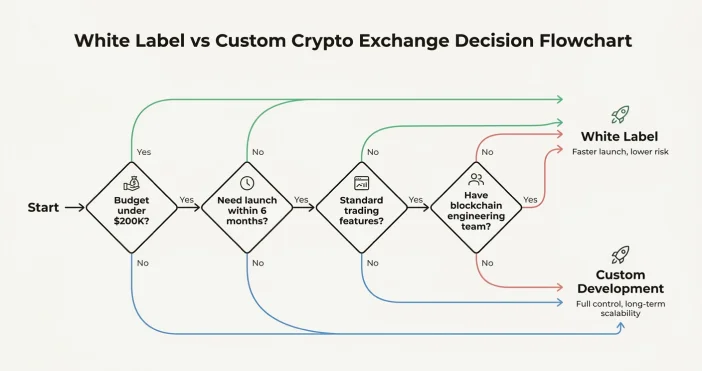
Choose white label if:
- Your total budget is under $200K
- You need to launch within 6 months
- You’re testing market demand before committing to full infrastructure
- Your trading product is standard — spot trading, basic derivatives, fiat-to-crypto pairs
- You don’t have a blockchain engineering team assembled yet
Choose custom development if:
- Your budget is $400K or above
- You need a proprietary trading product, custom algorithm, or unique market structure
- Source code ownership is required for IP protection or investor due diligence
- You’re targeting institutional clients with complex, jurisdiction-specific compliance needs
- You plan to operate across three or more regulatory frameworks simultaneously
And if you’re genuinely unsure: launch white label, prove the product works, and build custom when your revenue can fund it. That sequence is messier than it sounds, but it’s significantly less risky than a $600K custom build that runs out of runway before it launches.
Frequently Asked Questions
How much does white label crypto exchange software cost in 2026?
Expect $30K–$80K upfront for licensing, plus $10K–$40K for customization, and $3K–$8K/month in recurring fees. Total year-one cost typically lands between $75K and $200K depending on the vendor and feature set.
How long does it take to build a custom crypto exchange from scratch?
Between 12 and 18 months for a production-ready platform. The matching engine alone takes 3–4 months to build correctly. Security audits and compliance review add another 2–3 months before you’re ready to launch.
Can I own the source code with a white label exchange?
Some vendors offer a “white label with source code” option at a one-time fee of $80K–$200K. This gives you full codebase rights and the ability to self-host. Standard white label licenses don’t include source code ownership — confirm this in writing before you sign.
Is a white label exchange MiCA compliant?
It can be. Most enterprise-grade white label platforms include built-in KYC/AML modules, automated transaction monitoring, and FATF Travel Rule tooling. But compliance also depends on your operational setup and licensing jurisdiction, not just the software. Get legal sign-off regardless of which model you choose.
What’s the scalability difference between white label and custom?
Both can scale, but differently. White label scalability depends on your vendor’s infrastructure. If they hit capacity, you do too. Custom exchanges let you control your own infrastructure scaling — additional Node.js instances, database sharding, CDN configuration — on your own timeline and budget.
What is a hybrid crypto exchange model?
A hybrid model means launching white label first to validate the business, then migrating to a custom-built platform once traction is proven. It works best when the migration happens before you exceed around 1,000 active users. Beyond that threshold, live migrations get expensive and operationally risky.
Which is better for a crypto exchange MVP launch — white label or custom?
White label is almost always the right choice for an MVP. It gets you to market in weeks at a fraction of the cost. Use the MVP phase to validate your trading pairs, fee structure, and user acquisition approach. Build custom once you know what you’re actually building toward.

